
How This Keto Calculator Works: The Science Behind Your Macros
A deep dive into the keto calculator formula, the Mifflin-St. Jeor equation, and why accurate math is the key to weight loss.
Embarking on a ketogenic journey requires more than just cutting out bread; it requires a precise biological shift that turns your body into a fat-burning machine. To achieve this, you cannot rely on guesswork or generic advice found on forums. Our tool is built on a sophisticated keto calculator formula designed to provide you with the exact numbers needed to trigger and sustain ketosis.
The effectiveness of any dietary plan depends entirely on its ability to account for your unique metabolic profile. Two people of the same weight can have vastly different caloric needs depending on their height, age, and activity level. This is why we have developed an accurate keto calculator that looks at the whole picture. When you enter your personal data into our system, you aren’t just getting back a set of arbitrary numbers. You are receiving a roadmap tailored to your physiology.
Below, we strip away the mystery and explain exactly how our algorithms work, why we use specific medical equations, and how we ensure your macronutrient targets are optimized for your success.
👇 Calculate Your Personal Macros
Use our scientifically validated tool to find your baseline.
Your Personalized Results
Daily Target
0
kcal / day
The Scientific Foundation: Why Our Tool is an Accurate Keto Calculator
Many online calculators use simplified math that treats every user the same. They might subtract 500 calories from a standard 2,000-calorie diet and call it a plan. However, human metabolism is far more complex. The keto calculator formula we utilize is designed to respect the biological individuality of every user.
We prioritize precision because a mistake at the start of your journey can throw off your entire program. If your calorie target is too low, your metabolism may slow down to conserve energy (metabolic adaptation). If it is too high, you will fail to lose body fat even if you are in ketosis.
The core of our system is dedicated to transparency. We want our users to know that their health is being guided by established nutritional science. This is not a “one size fits all” approach; it is a customized strategy tailored to your specific physiological needs.
The Mifflin-St. Jeor Equation: The Gold Standard to Calculate BMR
You might be wondering where the base numbers come from. The primary engine behind our keto calculator formula is a specific, highly regarded mathematical model.
We use the Mifflin-St. Jeor equation, which is considered the gold standard for calculating Basal Metabolic Rate (BMR) by clinical studies.
In the world of clinical nutrition, there have been several formulas developed over the last century, such as the Harris-Benedict equation. However, as lifestyles have changed and body compositions have shifted in modern populations, older formulas have become less accurate. The Mifflin-St. Jeor equation, introduced in 1990, has been proven to be more reliable for the majority of the population, ranging from those who are underweight to those dealing with obesity.
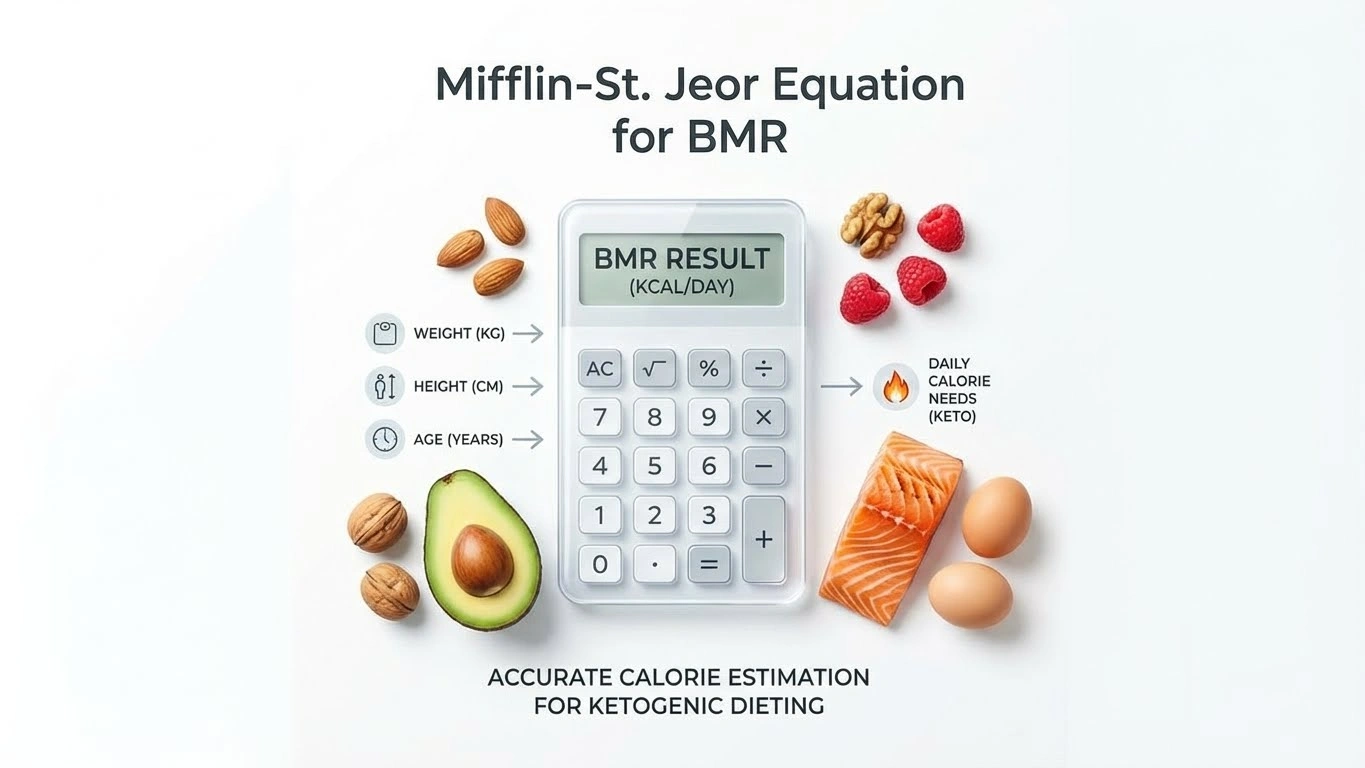
Briefly Explaining the Math: Step 1 – BMR
To understand how we determine your needs, it is helpful to look at the two-step process involved in the math. First, we calculate BMR. This stands for Basal Metabolic Rate. This figure represents the absolute minimum amount of energy (calories) your body requires to function while at complete rest. Imagine you were lying in bed all day, not moving, but your heart was beating, your lungs were breathing, your cells were dividing, and your brain was regulating your temperature.
(Where ‘s’ is a variable constant for gender)
By starting with this medical-grade calculation, we establish a solid baseline that ensures your diet plan is safe and sufficient for basic biological function.
Step 2: Applying the Activity Multiplier
Knowing your BMR is only half the battle. Unless you are bedbound, you burn more calories than your BMR suggests. We need to determine your Total Daily Energy Expenditure (TDEE).
Once we have your base BMR number, the keto calculator formula applies a multiplier based on your specific activity level. This reassures the user they are getting accurate, medical-grade data that reflects their real life, not a laboratory setting.
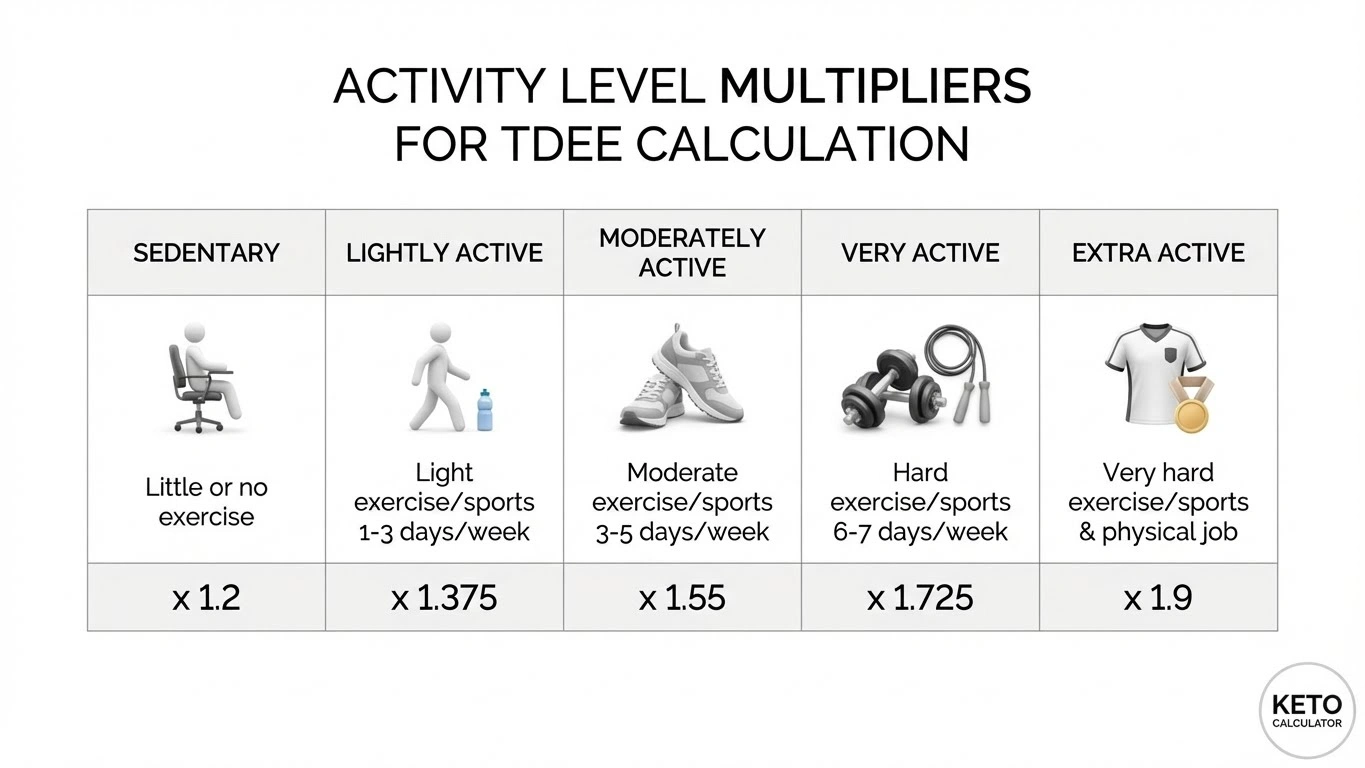
The multipliers we use are standard in dietetics:
- Sedentary: Little to no exercise, desk job. (BMR x 1.2)
- Lightly Active: Light exercise/sports 1-3 days/week. (BMR x 1.375)
- Moderately Active: Moderate exercise/sports 3-5 days/week. (BMR x 1.55)
- Very Active: Hard exercise/sports 6-7 days/week. (BMR x 1.725)
- Extra Active: Very hard exercise/physical job or training 2x/day. (BMR x 1.9)
Breaking Down the Keto Calculator Formula: From TDEE to Macros
Once we have calculated your TDEE (the total calories you burn in a day), the specialized work of the keto calculator begins. This is where we differ from a standard calorie counter. A generic calculator might suggest a split of 50% carbs, 30% protein, and 20% fat. On keto, that ratio would stop fat burning immediately.
Our keto calculator formula takes your TDEE and applies the specific macronutrient ratios required to induce physiological ketosis—a metabolic state where the body utilizes stored fat and dietary fats for energy instead of glucose.
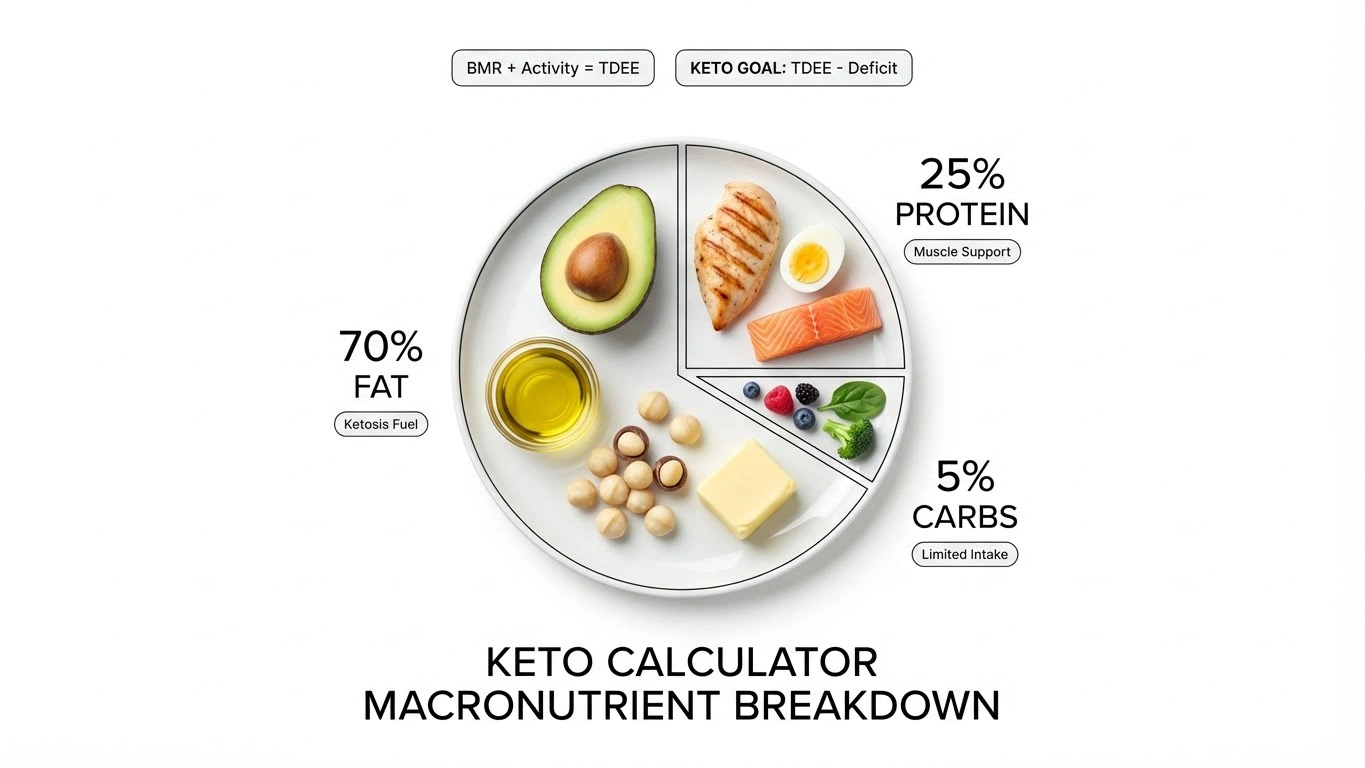
1. The Carb Limit (The Hard Ceiling)
The most critical variable in the formula is carbohydrates. To enter ketosis, liver glycogen must be depleted.
- Standard Input: We generally default to 20g or 25g of net carbs.
- Why: Clinical data shows that the vast majority of people will enter ketosis at this level.
- The Math: This usually represents only 5% of your total caloric intake.
2. The Protein Goal (The Anchor)
Protein is not a fuel source on keto; it is a structural requirement. The calculator determines your protein needs based on your lean body mass and activity level.
- If you are sedentary, the formula calculates roughly 0.6g to 0.8g of protein per pound of lean mass.
- If you lift weights or are highly active, the keto calculator formula increases this to 1.0g or 1.2g to prevent muscle atrophy.
This ensures you lose fat, not muscle.
3. The Fat Lever (The Variable)
This is where the magic happens. Fat is your new energy source. After calculating the calories for Carbs (fixed) and Protein (goal), the remaining calories in your allotment come from Fat.
Fat is a “lever.” If you want to lose weight, we reduce the dietary fat so your body burns its own stored fat. If you want to maintain weight, we increase dietary fat to match your energy expenditure.
Why “Body Fat Percentage” Improves the Keto Calculator Formula
You may notice that our calculator asks for your body fat percentage, though it is optional. We encourage you to input this if you know it. Why?
The Mifflin-St. Jeor equation is the gold standard to calculate BMR, but it makes assumptions about body composition. However, muscle tissue burns more calories at rest than fat tissue does.
Scenario A: A 200lb man with 10% body fat (very muscular).
Scenario B: A 200lb man with 35% body fat.
The man in Scenario A has a significantly higher metabolic rate because muscle is metabolically expensive tissue. If our keto calculator formula only looked at weight, it might treat these two men identically. By inputting your body fat percentage, our algorithm refines the BMR calculation (often switching to the Katch-McArdle derivative) to ensure your protein targets are high enough to support your lean mass and your calorie deficit isn’t too aggressive.
Visual Estimates vs. Scans
If you don’t have a DEXA scan or calipers, don’t worry. Our tool provides visual estimates to help you guide the accurate keto calculator toward the right numbers. Even a rough estimate helps refine the protein recommendations significantly.
The Role of the Caloric Deficit in the Formula
A common myth is that calories don’t matter on keto. While hormones (insulin) play a massive role, energy balance is still a law of physics. Our keto calculator formula allows you to choose your goal:
- Deficit (Weight Loss): We typically recommend a moderate deficit of 10% to 20%.
- Surplus (Muscle Gain): A surplus of 5% to 10% to support hypertrophy.
- Maintenance: 0% deficit.
Why Not a 50% Deficit?
You might be tempted to set the calculator to a massive deficit to lose weight faster. We advise against this. Our formula is designed to promote sustainable weight loss.
- Metabolic Downregulation: Drastic calorie cuts can cause your BMR to drop.
- Nutrient Deficiency: It is hard to get adequate micronutrients on very low calories.
- Muscle Loss: The body may break down muscle tissue for glucose (gluconeogenesis) if energy is too scarce.
Net Carbs vs. Total Carbs: How We Calculate
Precision matters when counting the nutrient that kicks you out of ketosis. Our calculator focuses on Net Carbs.
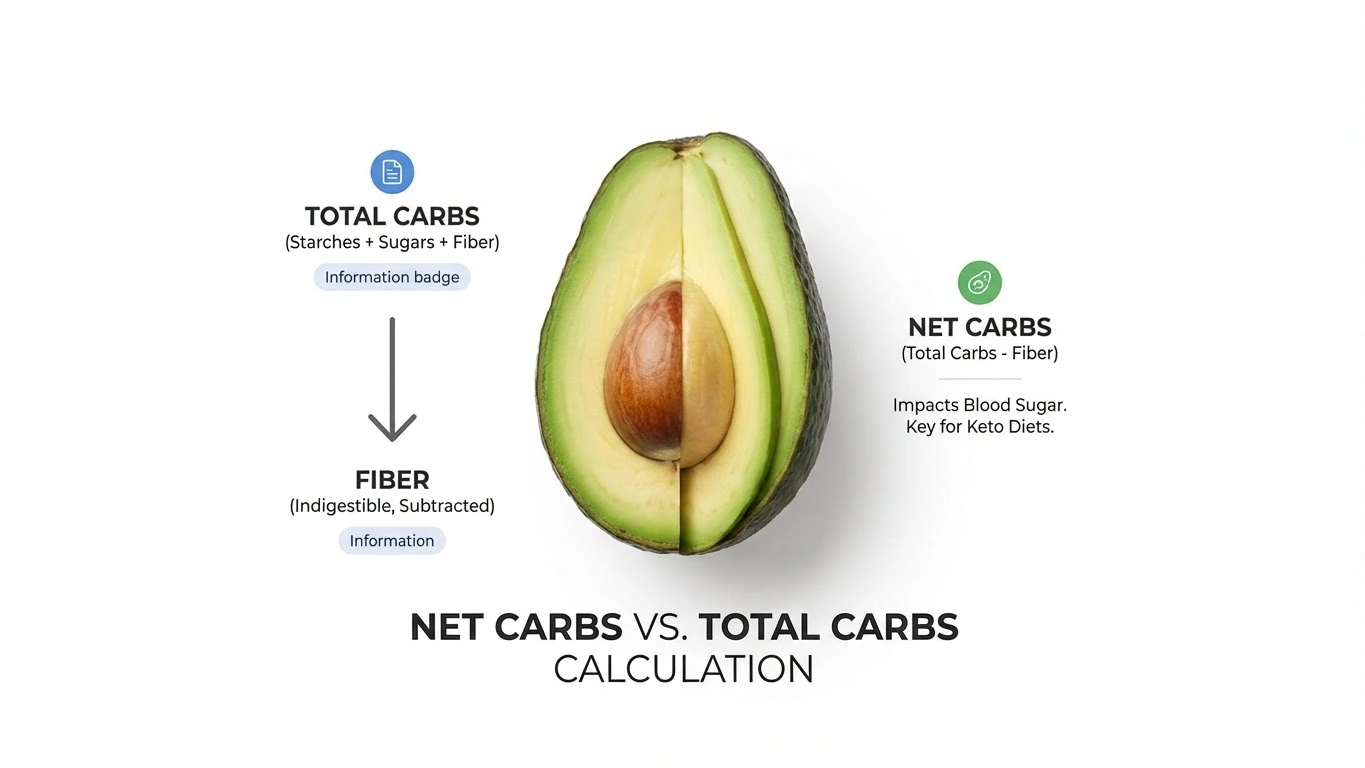
Fiber is a carbohydrate, but it is not digested by the human body into glucose. Therefore, it does not trigger an insulin response and does not inhibit ketosis. If we used Total Carbs in our keto calculator formula, you would be unfairly restricted from eating healthy, high-fiber foods like avocado, leafy greens, and chia seeds.
By calculating based on Net Carbs, our tool encourages a diet rich in vegetables and fiber, which is essential for gut health and long-term keto success.
Explore More Resources
For additional information check out these excellent resources on keto and metabolic health:
Calculate your personalized ketogenic macros and daily calorie targets with precision. This step-by-step guide helps you use our expert-verified calculator to achieve nutritional ketosis based on your unique metabolic data, including weight, height, and activity level.
Input Your Physical Metrics
Select your gender and enter your age, current weight, and height. You can toggle between US and Metric units for precision.
Set Lifestyle and Goals
Choose your activity level (from sedentary to extra active) and select your specific goal, such as ‘Lose Weight (-20% deficit)’.
Generate Your Personalized Keto Plan
Click ‘Calculate Macros’ to instantly receive your Daily Target Calories and a detailed breakdown of Fat (70%), Protein (25%), and Net Carbs (5%).