
Ultimate guide to keto friendly vegetables: 50+ options sorted by carb count
The definitive metabolic database of keto friendly vegetables — ranked by net carbohydrates, classified by glycemic impact, and optimized for sustained nutritional ketosis.
Quick answer
The best keto friendly vegetables are non-starchy, above-ground plants with exceptionally low net carbohydrate counts. Leafy greens like spinach and cruciferous options like cauliflower offer optimal micronutrients without disrupting nutritional ketosis. Practitioners must actively avoid starchy root vegetables like potatoes, corn, and cassava, prioritizing options containing under 5 grams of net carbs per serving.
Executive scientific summary
Maintaining nutritional ketosis requires precise carbohydrate management, making the selection of keto friendly vegetables a critical metabolic strategy. Non-starchy vegetables provide essential dietary fiber, potassium, and magnesium while exerting a minimal glycemic load. By focusing on net carbohydrates—total carbohydrates minus indigestible dietary fiber—practitioners can leverage the high nutrient density of leafy greens, brassicas, and alliums without triggering counterproductive insulin spikes.
This executive database categorizes over 50 keto vegetables, detailing their biochemical profiles and impact on endogenous ketone production. Optimized for clinical and practical application, this guide differentiates between optimal metabolic fuels and starchy tubers that risk reversing hepatic ketogenesis, ensuring stable energy expenditure and long-term metabolic flexibility.
The nutritional biochemistry of keto vegetables
To formulate a sustainable low-carbohydrate protocol, one must understand the physiological interaction between plant-based carbohydrates and the human metabolic system. Vegetables are not universally compatible with ketosis. Their carbohydrate density dictates whether they will support ketone production or trigger metabolic storage pathways.
Ketosis mechanisms and insulin response
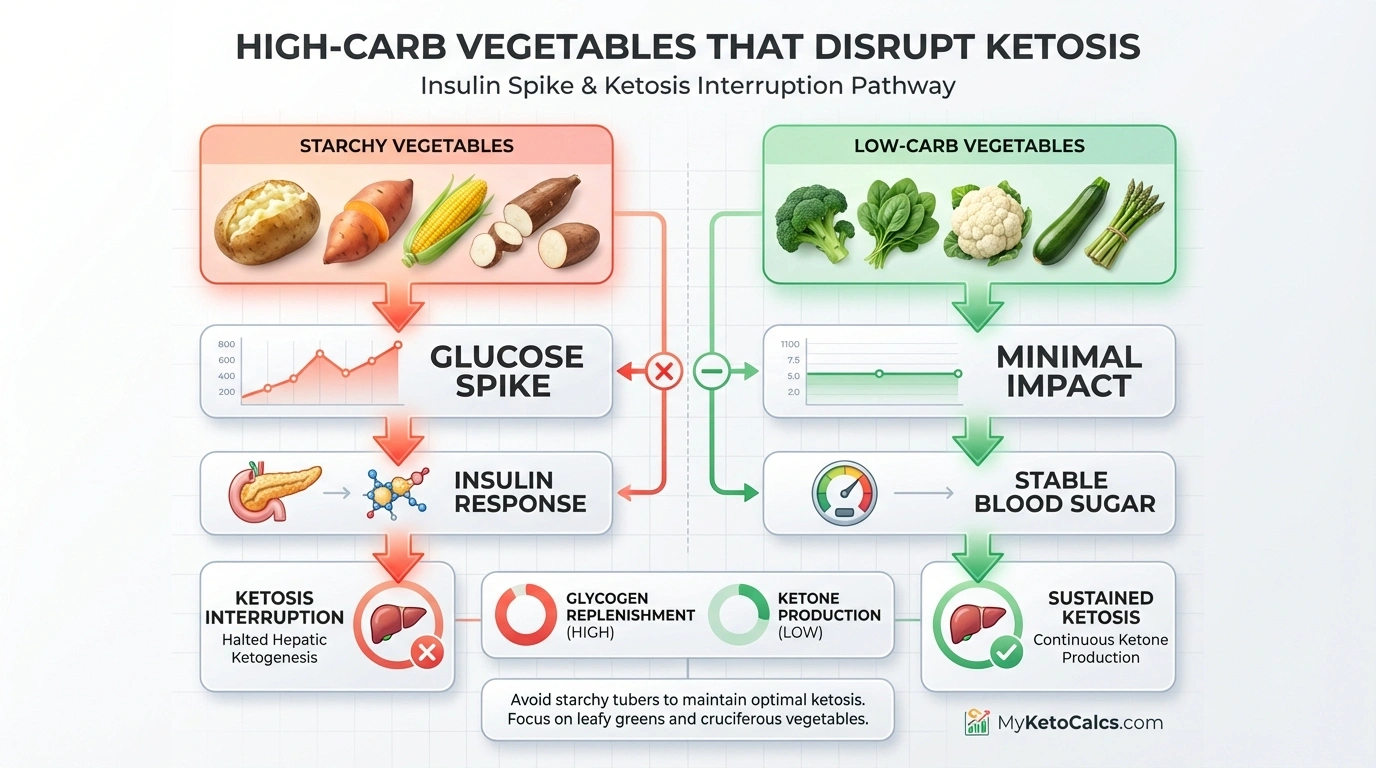
When carbohydrate intake is severely restricted, the body depletes its hepatic glycogen stores, forcing a systemic shift from glycolysis to mitochondrial beta-oxidation. In this state, the liver metabolizes fatty acids to produce ketone bodies (beta-hydroxybutyrate, acetoacetate, and acetone) which serve as an alternative ATP substrate for the brain and peripheral tissues.
Consuming starchy vegetables spikes blood glucose, which subsequently triggers an insulin response. Elevated insulin halts hepatic ketogenesis immediately by signaling the body to switch back to glucose metabolism and fat storage. Therefore, the primary objective when selecting keto friendly vegetables is to find fibrous plants that provide maximum micronutrients with minimal glycemic impact, maintaining a low insulin-to-glucagon ratio.
Fiber vs. net carbs logic
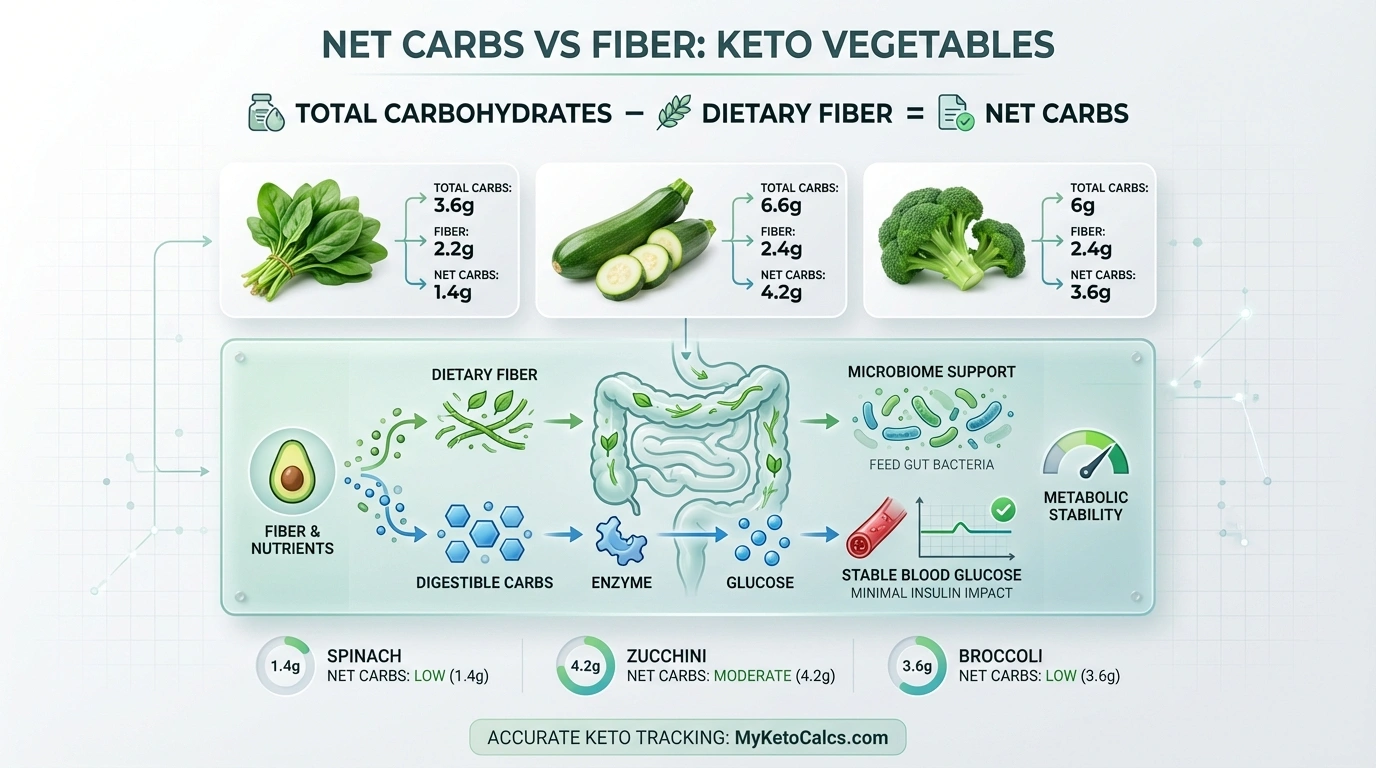
Not all carbohydrates disrupt ketosis. Carbohydrates are classified into digestible starches/sugars and indigestible dietary fiber. Because human digestive enzymes cannot break down fiber, it passes through the gastrointestinal tract without converting into glucose.
This biological mechanism brings us to the calculation of net carbs: total carbohydrates – dietary fiber = net carbs. This equation is the foundation of the ketogenic diet. The fiber feeds the gut microbiome, producing short-chain fatty acids (like butyrate) that actually suppress intestinal inflammation and support metabolic health, all while keeping blood glucose perfectly stable.
Keto vegetable chart: 50+ best vegetables for keto
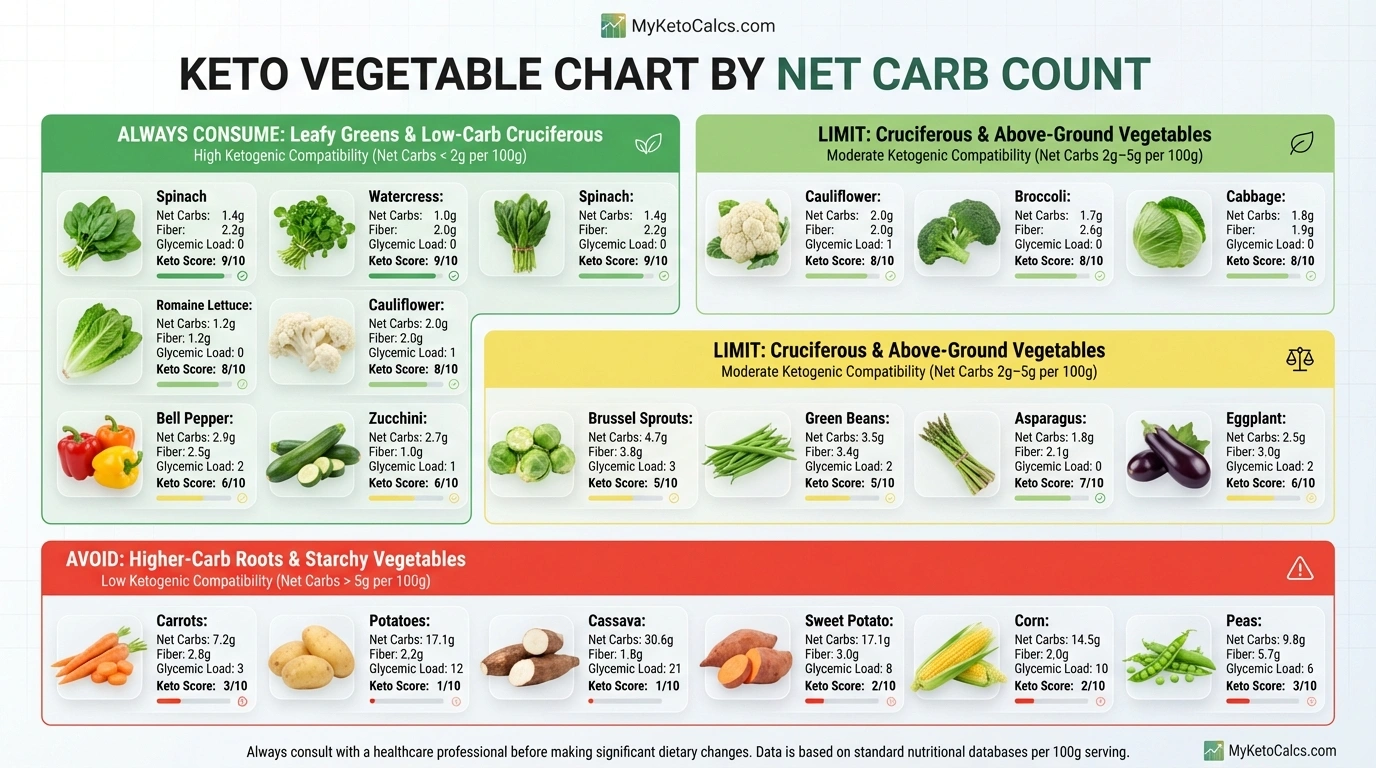
The following database provides a comprehensive breakdown of over 50 vegetables, sorted by their biochemical compatibility with a ketogenic diet. Data represents approximate net carbohydrates per 100-gram (3.5 oz) raw serving.
Group 1: “Always Consume” (0g – 4.3g net carbs)
Clinical note: these vegetables have a negligible to low impact on blood glucose and can be consumed liberally within daily carbohydrate targets.
| Vegetable name | Category | Net carbs (g) | Metabolic recommendation |
|---|---|---|---|
| Watercress | Leafy Green | 0.4g | Always consume |
| Spinach | Leafy Green | 1.4g | Always consume |
| Mustard Greens | Leafy Green | 1.6g | Always consume |
| Celery | Stem Vegetable | 1.4g | Always consume |
| Cucumber (peeled) | Fruiting Veggie | 1.6g | Always consume |
| Arugula | Leafy Green | 2.0g | Always consume |
| Asparagus | Stem Vegetable | 2.0g | Always consume |
| Avocado | Fruiting Veggie/Fat | 2.0g | Always consume |
| Radish | Root (Exception) | 2.0g | Always consume |
| Swiss Chard | Leafy Green | 2.1g | Always consume |
| White Mushrooms | Fungi | 2.2g | Always consume |
| Romaine Lettuce | Leafy Green | 2.3g | Always consume |
| Zucchini | Fruiting Veggie | 2.3g | Always consume |
| Eggplant | Fruiting Veggie | 2.3g | Always consume |
| Cauliflower | Cruciferous | 3.0g | Always consume |
| Cabbage (Green) | Cruciferous | 3.0g | Always consume |
| Bell Pepper (Green) | Fruiting Veggie | 3.0g | Always consume |
| Kale | Leafy Green | 3.6g | Always consume |
| Broccoli | Cruciferous | 4.0g | Always consume |
| Green Beans | Legume/Pod | 4.3g | Always consume |
Group 2: “Limit” (4.6g – 8.7g net carbs)
Clinical note: these present “carb creep” risks. Consume in small quantities or reserve for targeted ketogenic phases (e.g., post-workout). Monitor total daily intake carefully.
| Vegetable name | Category | Net carbs (g) | Metabolic recommendation |
|---|---|---|---|
| Brussels Sprouts | Cruciferous | 4.6g | Limit |
| Snow Peas | Legume/Pod | 4.9g | Limit |
| Artichoke Hearts | Flower | 5.2g | Limit |
| Spaghetti Squash | Squash | 5.5g | Limit |
| Edamame (Soy) | Legume | 5.7g | Limit (Avoid Clean Keto) |
| Celeriac | Root | 5.8g | Limit |
| Turnips | Root | 6.1g | Limit |
| Pumpkin | Squash | 6.9g | Limit |
| Kohlrabi | Cruciferous | 4.8g | Limit |
| Fennel | Stem/Bulb | 3.7g | Limit |
| Tomato (Roma/Cherry) | Fruiting Veggie | 3.8g | Limit |
| Garlic | Allium | 0.9g (per clove) | Limit |
| Carrots | Root | 8.7g | Limit |
| Onions (Yellow) | Allium | 8.7g | Limit |
Group 3: “Avoid” (>8.7g net carbs)
Clinical note: these starchy tubers, legumes, and high-carb vegetables will inhibit ketogenesis and trigger significant insulin spikes. Eliminate entirely from a strict ketogenic protocol.
| Vegetable name | Category | Net carbs (g) | Metabolic recommendation |
|---|---|---|---|
| Beetroot | Root | 8.7g | Avoid |
| Rutabaga | Root | 8.9g | Avoid |
| Black Beans | Legume | 13.0g | Avoid |
| Corn | Grain/Starch | 14.7g | Avoid |
| Navy Beans | Legume | 14.0g | Avoid |
| Peas | Legume | 14.4g | Avoid |
| Butternut Squash | Squash | 15.0g | Avoid |
| Pinto Beans | Legume | 15.0g | Avoid |
| White Potatoes | Tuber | 16.0g | Avoid |
| Parsnips | Root | 16.4g | Avoid |
| Sweet Potatoes | Tuber | 17.3g | Avoid |
| Acorn Squash | Squash | 20.0g | Avoid |
| Yams | Tuber | 27.4g | Avoid |
| Adzuki Beans | Legume | 40.0g | Avoid |
| Plantains | Fruit/Starch | 54.0g | Avoid |
| Cassava (Yuca) | Tuber | 75.0g | Avoid |
Depth & authority: metabolic profiles of major keto vegetables
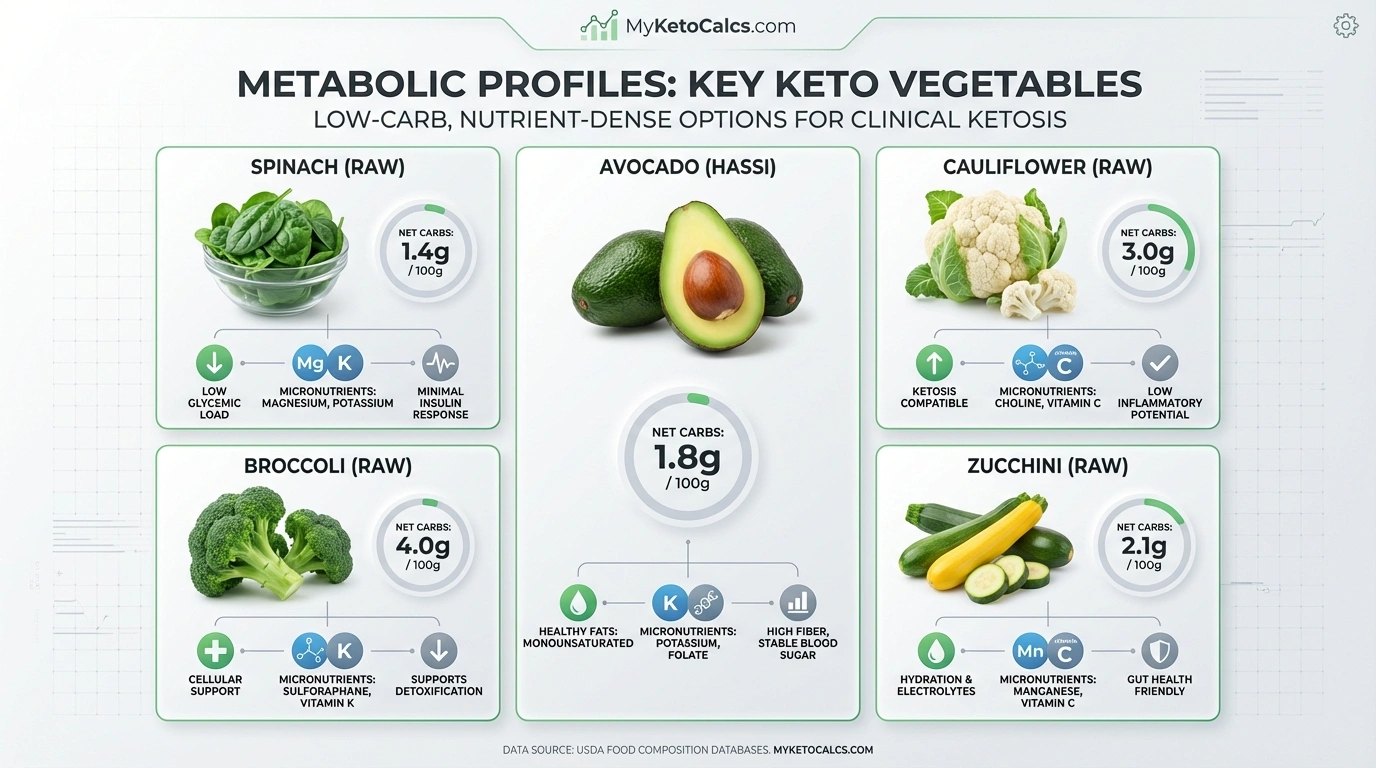
To master clinical ketogenic nutrition, one must look beyond simple carbohydrate counts and examine how specific vegetables influence endogenous hormonal environments. Below is an authoritative breakdown of the best vegetables for keto diets.
Spinach
- Metabolic profile: Exceptionally low glycemic load. With roughly 1.4 grams of net carbs per 100 grams, spinach generates zero measurable insulin spike and supports sustained beta-oxidation.
- Practical keto application: Highly versatile; can be consumed raw in salads or sautéed in healthy fats like grass-fed butter or tallow to increase nutrient absorption.
- Biochemical reasoning (Always Consume): Spinach provides profound amounts of magnesium and potassium, two intracellular electrolytes critical for preventing the “keto flu” and supporting myocardial electrical stability.
Cauliflower
- Metabolic profile: Contains roughly 3.0 grams of net carbs per 100 grams. It triggers an insignificant insulin response, maintaining a highly favorable environment for ketone generation.
- Practical keto application: Acts as the ultimate culinary chameleon. It can be riced, mashed, or baked into pizza crusts to satisfy cravings for high-carbohydrate staples.
- Biochemical reasoning (Always Consume): Rich in choline and Vitamin C. Its high fiber content creates gastric distension, promoting mechanical satiety without introducing glycemic sugars.
Avocado
- Metabolic profile: Yields approximately 2.0 grams of net carbs against 10 grams of dietary fiber per 100 grams. Avocado actively promotes ketosis due to its dense concentration of monounsaturated fatty acids (oleic acid).
- Practical keto application: The ultimate fat-delivery vehicle. Slice it over salads, blend it into smoothies, or mash it for guacamole.
- Biochemical reasoning (Always Consume): Though botanically a fruit, avocado’s lipid profile makes it a ketogenic superfood. It lowers LDL cholesterol while increasing insulin sensitivity and providing essential metabolic fuel.
Broccoli
- Metabolic profile: Delivers 4.0 grams of net carbs per 100 grams. It possesses a low glycemic index and provides sustained, slow-digesting energy.
- Practical keto application: Best served roasted with olive oil or steamed with heavy cream and cheese sauces to elevate the macronutrient fat ratio.
- Biochemical reasoning (Always Consume): Contains sulforaphane, a potent antioxidant that supports hepatic detoxification pathways. It also provides high levels of Vitamin K and structural fiber for microbiome health.
Zucchini
- Metabolic profile: Offers a mere 2.3 grams of net carbs per 100 grams. Its high water content makes it virtually transparent to the body’s insulin receptors.
- Practical keto application: Can be spiralized into “zoodles” to replace wheat pasta, minimizing carbohydrate intake by over 90% in traditional Italian dishes.
- Biochemical reasoning (Always Consume): Zucchini hydrates the cellular matrix while delivering manganese and potassium, assisting with enzyme synthesis and muscular contraction during early keto adaptation.
Onion and Garlic
- Metabolic profile: Moderately high glycemic load. Onions possess around 8.7 grams of net carbs per 100 grams, which can disrupt ketone production if consumed in high volumes.
- Practical keto application: Use strictly as aromatic flavor enhancers rather than bulk base ingredients. Dicing small amounts into a stir-fry is acceptable.
- Biochemical reasoning (Limit): As subterranean bulbs, onions and garlic store concentrated fructose and fructans. While they offer beneficial compounds like quercetin and allicin, their starch density requires strict portion control.
Potatoes and Sweet Potatoes
- Metabolic profile: Extremely high glycemic impact. White potatoes contain over 16 grams of net carbs per 100 grams, triggering massive insulin spikes that instantly halt hepatic ketogenesis.
- Practical keto application: None. These should be completely eliminated from the ketogenic kitchen.
- Biochemical reasoning (Avoid): These starchy tubers break down rapidly into raw glucose inside the digestive tract. Eating even a small portion will restock liver glycogen, effectively ejecting the practitioner from a state of fat-burning ketosis.
👇 Establish Your Metabolic Boundaries
Even if you’re focused on vegetables and net carbs, rely on data, not intuition. Find your baseline.
Your Personalized Results
Daily Target
0
kcal / day
Hidden carb risks & beginner vs. adapted keto metabolism
When managing a low-carb veggie database, practitioners must look out for hidden metabolic pitfalls. Cooking methods significantly alter the glycemic density of plant foods.
For instance, raw spinach appears massive on a plate but cooks down to a fraction of its size. Consuming 100 grams of raw spinach is easy and yields 1.4g of net carbs, but eating 100 grams of cooked, drained spinach represents a much larger amount of plant matter, doubling the functional carb count to nearly 3g. Similarly, caramelizing onions breaks down complex plant walls, exposing simple sugars and increasing the immediate glycemic load.
There is also a distinct difference between beginner and adapted metabolic states. Beginners suffering from insulin resistance lack the mitochondrial density to efficiently oxidize fat. For these individuals, total carbohydrate restriction must remain strictly under 20 grams of net carbs daily to force glycogen depletion. Beginners should exclusively consume ultra-low-carb leafy greens.
Conversely, individuals who are “keto-adapted” have developed an abundance of fat-burning enzymatic machinery. Adapted athletes can often consume up to 50 grams of net carbs without breaking ketosis. These individuals enjoy greater metabolic flexibility and can safely incorporate marginal root vegetables like carrots or moderate portions of winter squash.
Methodology: formulating the ultimate low carb veggies database
To establish clinical accuracy within this keto vegetable chart, robust data synthesis was required. All nutritional values were extracted directly from the USDA FoodData Central database and the German Federal Research Institute of Nutrition and Food.
Our methodology strips away pseudo-science by strictly relying on biochemical macronutrient isolation. We subtract indigestible fibrous polymers from total carbohydrate counts to arrive at the physiological net carb value. This ensures that our recommendations reflect actual endogenous insulin responses rather than theoretical dietary guidelines. Furthermore, starchy legumes and tubers were systematically disqualified based on their high glycemic index and propensity to stimulate gluconeogenesis.
Primary data source: USDA FoodData Central database and the German Federal Research Institute of Nutrition and Food (MRI) for standardized 100g measurements.
Methodology: Net carbs are calculated by subtracting indigestible fibrous polymers from total carbohydrate counts. Starchy legumes and tubers are systematically disqualified based on their high glycemic index and propensity to stimulate gluconeogenesis.
Contrarian section: debunking common keto vegetable myths
The ketogenic space is plagued by physiological misunderstandings. Let us aggressively debunk the most prominent fallacies regarding keto vegetables.
Myth 1: you must avoid all vegetables to stay in deep ketosis.
The rise of the strict zero-carb “carnivore” movement has led many to mistakenly believe that vegetables are toxic or counterproductive to ketosis. In reality, abandoning non-starchy vegetables strips the gut microbiome of prebiotic dietary fiber. Without fiber to ferment into short-chain fatty acids, the gut’s mucosal lining degrades, leading to systemic inflammation. Low-carb vegetables are essential for providing the electrolytes necessary to maintain healthy nerve conduction.
Myth 2: tomatoes and carrots are strictly forbidden.
Many restrictive guides claim that eating a single carrot or tomato will destroy ketosis. This ignores the biological principle of dose-dependent metabolic responses. While a whole plate of carrots carries a high glycemic load, shredding 15 grams of carrot over a high-fat salad contributes less than 1 gram of net carbs. Ketosis is dictated by total daily glycemic load, not by the mere presence of a specific plant compound.
Myth 3: sweet potatoes are a “slow carb” and therefore keto-friendly.
Despite their reputation in standard fitness circles as a healthy, complex carbohydrate, sweet potatoes are metabolically incompatible with ketosis. A single serving contains roughly 17 grams of net carbs. Regardless of their fiber content, the sheer volume of starch will rapidly replenish hepatic glycogen stores and spike insulin, effectively shutting down fat oxidation.
Frequently asked questions (FAQ)
What are the absolute lowest-carb vegetables?
The vegetables with the lowest net carbohydrate counts are leafy greens like watercress, spinach, and lettuce. Fungi like white button mushrooms and watery fruiting vegetables like cucumbers and zucchini also rank exceptionally low, typically containing under 2.5 grams of net carbs per 100 grams.
Can I eat onions and garlic on a keto diet?
Yes, but they must be strictly monitored. Both onions and garlic grow underground and contain highly concentrated sugars and starches. They should be utilized as aromatic flavor enhancers in very small quantities, rather than consumed as a primary vegetable side dish.
Are canned or frozen vegetables keto-friendly?
Absolutely. Frozen vegetables are typically flash-frozen at peak ripeness, preserving their full micronutrient profile without altering their carbohydrate count. When purchasing canned vegetables, always check the label to ensure they are packed in water and free from added sugars or chemical preservatives.
How many servings of vegetables should I eat per day on keto?
You should aim to fill at least half of your plate with non-starchy, low-carb vegetables at every meal. Depending on your specific macronutrient limit (typically 20-50g net carbs), you can easily consume 5 to 7 cups of leafy greens and cruciferous vegetables daily while remaining safely in ketosis.
Do calories from keto vegetables matter?
Yes, total caloric intake always matters for body composition changes. However, non-starchy vegetables are incredibly low in calories and high in water and fiber, making it physically difficult to overeat them. Their primary function is providing volume and satiety without contributing excess energy.
What vegetables are highest in carbs to avoid?
You must strictly avoid all tubers, roots, and starchy legumes. White potatoes, sweet potatoes, yams, cassava, corn, peas, and parsnips contain massive amounts of glucose-forming starches. Consuming these will immediately trigger an insulin response and halt hepatic ketone production.
Does cooking vegetables alter their net carbohydrate count?
Cooking does not magically create new carbohydrates, but it does remove water and shrink the physical volume of the plant. A cup of raw spinach has about 0.4 grams of net carbs, while a cup of cooked spinach is densely packed and contains over 3.0 grams of net carbs. Always track macros based on the state in which the food is consumed.
Further Reading & Tools
Explore More Resources
For additional information, check out these excellent resources on keto-friendly vegetables: