
Understanding what is TDEE vs. BMR: the math behind your macros
Understand the two numbers that determine how many calories your body needs — and how to use them to reach your goals.
Quick Answer: BMR (Basal Metabolic Rate) is the number of calories your body burns at complete rest to keep vital organs functioning. TDEE (Total Daily Energy Expenditure) is your BMR plus all additional calories burned through digestion, daily movement, and exercise. TDEE is the number you use to set your calorie target.
For anyone starting a weight management journey—particularly one involving a metabolic shift like the ketogenic diet—success relies less on guesswork and more on understanding the numbers that govern energy balance. Two acronyms frequently come up: BMR and TDEE. While they are often conflated in casual conversation, understanding the difference between BMR and TDEE is essential for setting a realistic and sustainable calorie target.
These numbers are not arbitrary. BMR represents your body’s baseline energy requirement — the minimum calories needed to stay alive. TDEE represents the full cost of your day. This article explains both concepts clearly, shows you how to calculate them, and explains how to use them to manage your weight on a ketogenic or low-carb diet.
Educational note: This article is for educational purposes only and is not medical advice. If you have diabetes, take glucose-lowering medication, are pregnant or breastfeeding, have kidney disease, or have a history of eating disorders, speak with a qualified healthcare professional before making major dietary changes.
The physiological baseline: Basal Metabolic Rate (BMR)
BMR (Basal Metabolic Rate) is the number of calories your body needs to perform its most basic life-sustaining functions while at complete rest — heart beating, lungs breathing, brain functioning, cells regenerating. It is the minimum energy your body needs simply to exist.
Imagine a scenario where you are completely inactive for 24 hours—lying in bed, not moving, not digesting food, and in a state of thermal neutrality. The energy required solely to keep your heart beating, your lungs ventilating, your blood circulating, your cells regenerating, and your brain processing signals constitutes your BMR.
The organ demand
It is a common misconception that muscles burn the majority of calories at rest. In reality, your internal organs are metabolic powerhouses. Approximately 60% to 75% of your total daily energy expenditure is driven by BMR. The liver, brain, heart, and kidneys demand a continuous supply of energy (adenosine triphosphate, or ATP) to maintain homeostasis.
- The brain: consumes roughly 20% of resting energy.
- The liver: a primary site for metabolism, consuming significant energy.
- Skeletal muscle: while important, resting muscle contributes less to BMR than internal organs, though increasing muscle mass does elevate BMR over time.
Why you should not eat below your BMR
A common mistake when seeking rapid weight loss is restricting calorie intake below BMR. When you consistently eat fewer calories than your BMR, your body does not have enough energy to maintain essential physiological functions.
If energy intake stays below this threshold, the body may initiate adaptive thermogenesis — sometimes called “starvation mode.” To protect vital organs, the body may downregulate thyroid function, reduce daily movement, and break down muscle tissue for fuel. This metabolic adaptation slows weight loss and is difficult to reverse. Treat your BMR as a caloric floor, not a target. If you are considering very low calorie approaches, speak with a qualified healthcare professional first.
What is TDEE? The total daily energy expenditure equation
TDEE stands for Total Daily Energy Expenditure. It represents the comprehensive total of all calories your body burns in a 24-hour period — including resting functions, digestion, daily movement, and exercise. TDEE is the number that tells you exactly how much to eat to maintain, lose, or gain weight.
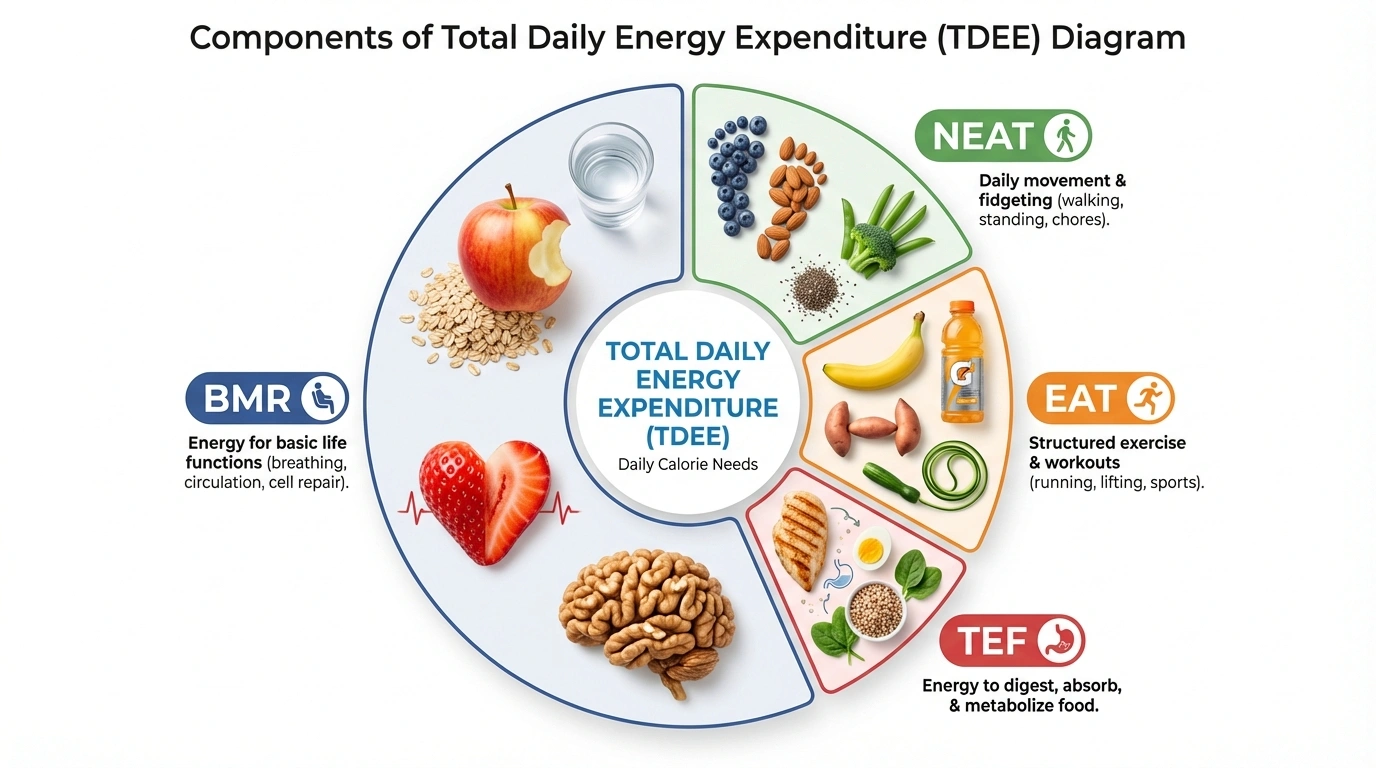
Mathematically, TDEE is the aggregate of four distinct components:
| Component | Approx. % of TDEE | What it covers |
|---|---|---|
| Basal Metabolic Rate (BMR) | ~70% | Calories burned at complete rest: heart, lungs, brain, organs. |
| Thermic Effect of Food (TEF) | ~10% | Energy used to digest, absorb, and process food and nutrients. |
| Non-Exercise Activity Thermogenesis (NEAT) | ~15% | Calories burned through all daily movement outside structured exercise. |
| Exercise Activity Thermogenesis (EAT) | ~5% | Calories burned during planned workouts and intentional exercise. |
Percentages are approximate and vary by individual lifestyle and activity level.
Understanding TDEE requires analyzing these variables, as they explain why two individuals of the same weight and height can have vastly different caloric requirements.
The thermic effect of food (TEF)
Every time you eat, your body must expend energy to process that fuel. This is the thermic effect of food. Interestingly, different macronutrients trigger different thermic responses. Protein is the most metabolically expensive macronutrient to digest, requiring 20-30% of its caloric value for processing. For people on a ketogenic diet, moderate protein intake ensures a sustained TEF, whereas dietary fats have the lowest thermic effect (0-3%). However, the metabolic advantage of ketosis involves other pathways that optimize fat oxidation.
Non-exercise activity thermogenesis (NEAT)
NEAT is often the most underestimated variable when calculating TDEE. NEAT encompasses all the calories burned through subconscious or routine movements: walking to the car, typing, fidgeting, maintaining posture, and performing household chores. In sedentary populations, NEAT is low. In active individuals—even those who do not go to the gym but have active jobs—NEAT can account for a significant portion of the difference between BMR and TDEE. Fluctuations in NEAT often explain why some people maintain weight easily while others struggle, despite similar diets.
👇 Establish Your Metabolic Boundaries
Calculate your TDEE based on validated formulas.
Your Personalized Results
Daily Target
0
kcal / day
0 g
0 g
0 g
The difference between BMR and TDEE
Key insight: BMR is a fixed baseline — it changes slowly with age or body composition shifts. TDEE is dynamic — it changes day to day based on how active you are. If you only know your BMR, you are missing 30–40% of the calories your body actually burns each day.
Understanding the difference between BMR and TDEE matters for setting an accurate calorie target.
| Feature | BMR | TDEE |
|---|---|---|
| What it measures | Calories burned at complete rest | Total calories burned in a full day |
| Changes day to day? | No — relatively stable | Yes — changes with activity level |
| Determined by | Age, sex, height, weight, body composition | BMR + activity level + food intake + exercise |
| How to use it | Sets the minimum calorie floor | Sets the maintenance and deficit target |
| Recalculation needed? | Only when weight or composition changes significantly | Recalculate every 5–10 lb of weight loss |
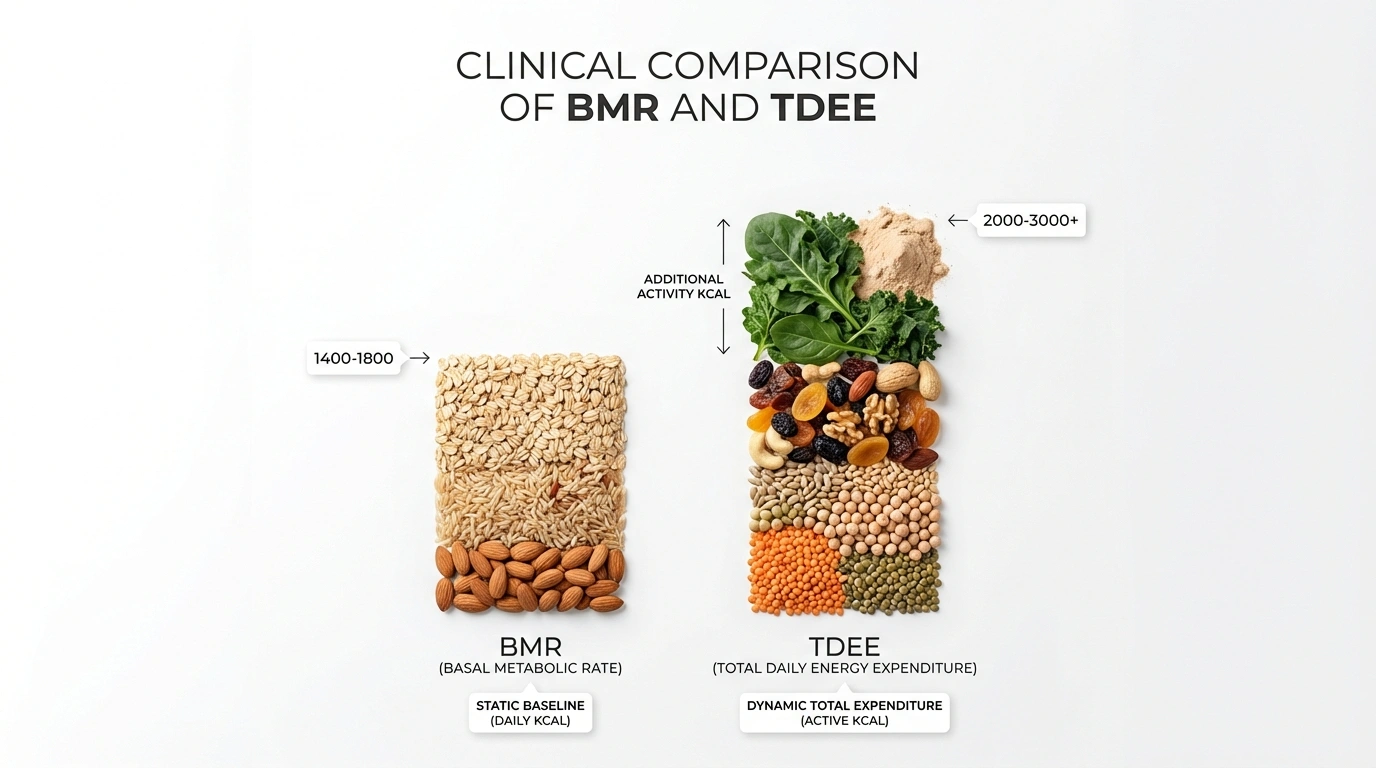
When using a calorie calculator, you are ultimately trying to estimate TDEE to establish calories for maintenance. If you only calculate BMR, you are missing the energy expenditure from 30% to 40% of your day.
Mathematical models: calculating your metabolic rate
The most widely used method for estimating BMR is a validated mathematical formula. While indirect calorimetry (breathing into a specialized machine) is the most accurate measurement available, it requires clinical equipment. The predictive equations below are the standard approach for practical use.
The Mifflin-St Jeor equation
Currently, the Mifflin-St Jeor equation is considered the most accurate formula for the general population. It was developed in 1990 and has largely replaced the older Harris-Benedict equation due to its precision in estimating resting energy expenditure in modern demographics.
bmr = (10 × weight [kg]) + (6.25 × height [cm]) – (5 × age [years]) + 5
bmr = (10 × weight [kg]) + (6.25 × height [cm]) – (5 × age [years]) – 161
Once BMR is established via this calculation, we must apply the appropriate activity factor to determine TDEE.
Applying activity factors (PAL)
To convert BMR into TDEE, we multiply the BMR by a Physical Activity Level (PAL) value. Honesty in selecting this factor is crucial for accurate results.
| Activity Level | PAL Multiplier | Description |
|---|---|---|
| Sedentary | BMR × 1.2 | Little to no exercise; desk job or mostly seated lifestyle. |
| Lightly active | BMR × 1.375 | Light exercise or sports 1–3 days per week. |
| Moderately active | BMR × 1.55 | Moderate exercise or sports 3–5 days per week. |
| Very active | BMR × 1.725 | Hard exercise 6–7 days per week or a physically demanding job. |
| Extra active | BMR × 1.9 | Very hard exercise, physical job, or training twice per day. |
For example, someone with a BMR of 1,400 kcal who works a desk job but exercises 3 times a week would calculate:
In this scenario, 1,925 kcal represents this person’s calories for maintenance.
Establishing calories for maintenance and caloric deficits
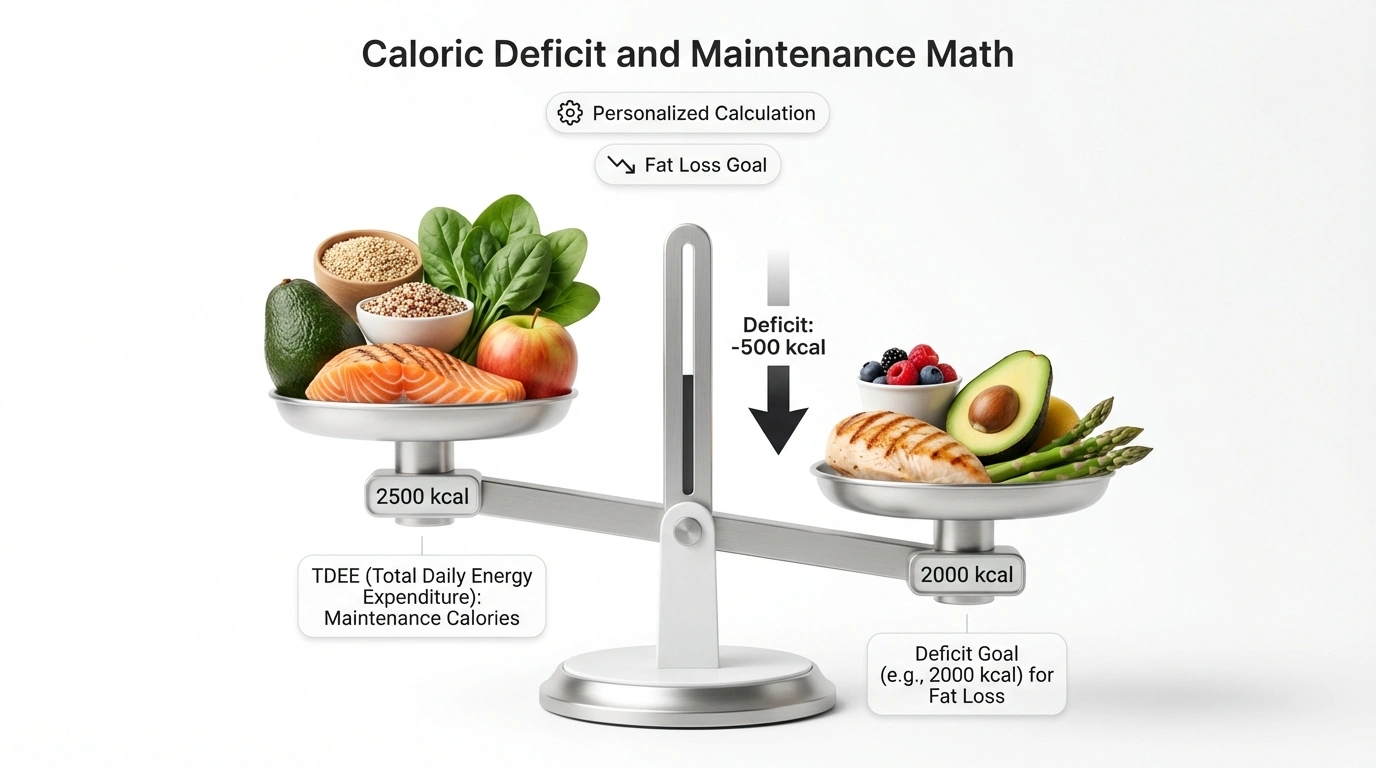
Once you have calculated your TDEE, you have your maintenance number — the exact calories that keep your weight stable. To lose weight, eat below it. To gain, eat above it. To maintain, match it. This single number is the starting point for all calorie and macro planning.
The mathematics of weight loss
To lose body fat, you must induce a negative energy balance. However, the magnitude of this deficit matters.
- Conservative deficit (10-15%): slow weight loss, high muscle retention, sustainable.
- Moderate deficit (20-25%): the standard recommendation for healthy, steady weight loss.
- Aggressive deficit (>25%): increases the risk of metabolic adaptation and muscle loss.
If we return to the previous example of someone with a TDEE of 1,925 kcal, to achieve a moderate 20% deficit, the math is:
1,925 – 385 = 1,540 kcal/day target
This target (1,540 kcal) is well above their BMR (1,400 kcal), ensuring they fuel their vital organs while still prompting the body to utilize stored adipose tissue (body fat) for the missing energy.
Why calories for maintenance change
It is vital to understand that your TDEE is a moving target. As you lose weight, your BMR decreases because there is less body mass to support. Furthermore, as you become smaller, you burn fewer calories during movement (NEAT). Therefore, you must recalculate TDEE after every 5-10 pounds of weight loss to ensure your calorie target remains accurate.
From TDEE to macros: the keto application
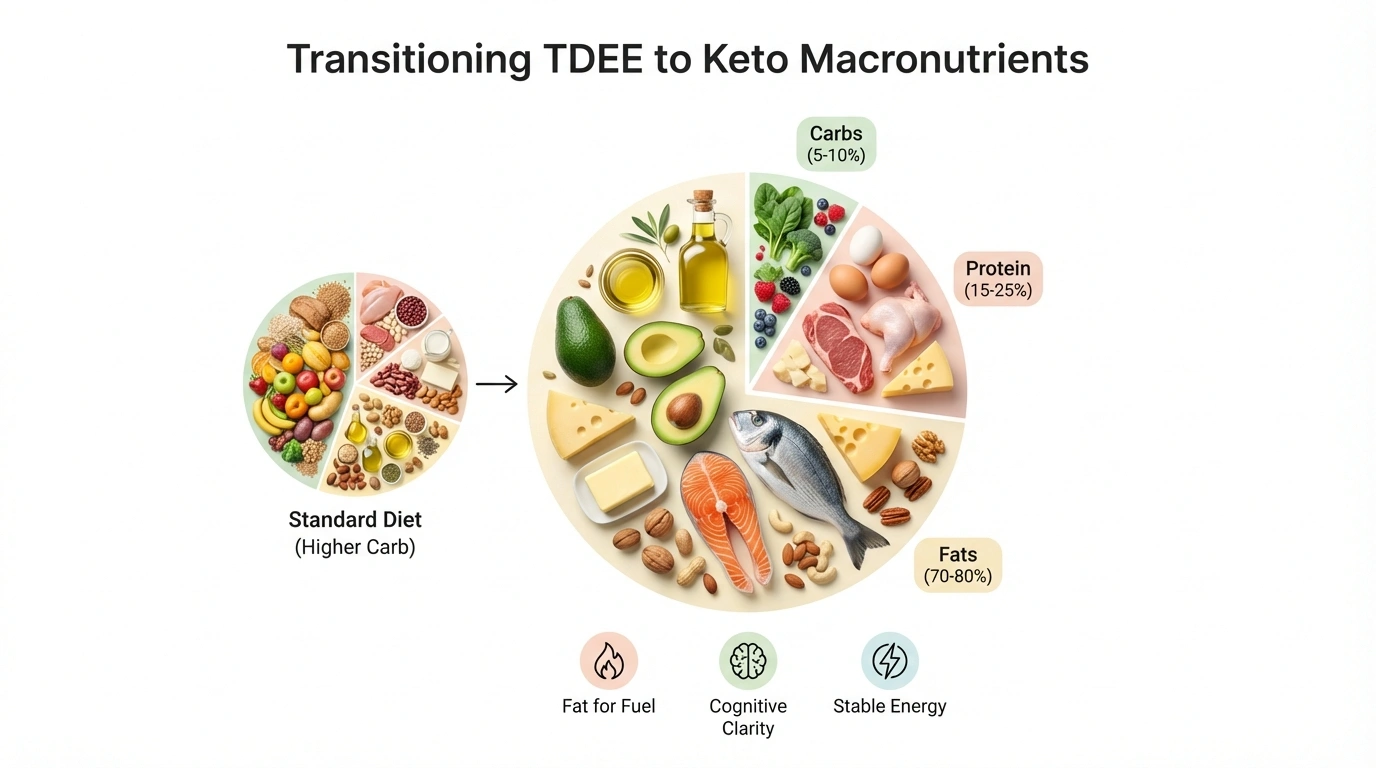
Understanding TDEE is merely the first step. The second step is partitioning those calories into macronutrients: protein, fats, and carbohydrates. This is where the “keto” aspect of the calculator becomes relevant. While TDEE determines how much weight you lose, your macronutrient split determines what kind of weight you lose (muscle vs. fat) and how you feel during the process.
- Protein: this is the first macro to calculate. It is essential for muscle repair and satiety. A standard recommendation is 0.7 to 1.0 grams per pound of lean body mass or goal weight. This protects muscle tissue during a caloric deficit.
- Carbohydrates: on a ketogenic diet, this is a fixed limit, usually between 20g and 50g of net carbs per day to maintain ketosis.
- Fats: fat acts as a lever. Once protein and carb limits are set, the remaining calories from your TDEE (or deficit target) are filled with fat.
The analytical advantage of tracking
Many people ask why they must track these numbers if they are eating “clean” foods. The answer lies in the law of thermodynamics. Even on a ketogenic diet, if your energy intake exceeds your TDEE, you will not lose weight. While ketosis optimizes fat oxidation and regulates hunger hormones like ghrelin, it does not negate the physics of energy balance. Knowing your TDEE allows you to audit your intake objectively. Use our free keto macros calculator to apply these numbers to your personal targets. If weight loss stalls (a plateau), it is often because the TDEE has dropped due to weight loss, or caloric intake has drifted upward—a phenomenon known as “calorie creep.”
Factors influencing the difference between BMR and TDEE
While the formulas provided are robust, individual variance exists. As an objective observer of your own health, you must account for factors that might skew the calculation of TDEE.
- Muscle mass: the Mifflin-St Jeor equation does not account for body fat percentage. Individuals with high muscle mass may have a higher BMR than predicted, while those with low muscle mass (sarcopenia) may have a lower BMR.
- Age: BMR typically decreases by 1-2% per decade after age 20 due to hormonal changes and muscle loss.
- Hormonal status: thyroid disorders (hypothyroidism) or hormonal imbalances (PCOS) can lower BMR below the predicted values.
- Genetics: some individuals naturally possess a higher level of NEAT (fidgeting, pacing), which significantly increases the difference between BMR and TDEE without conscious effort.
Because of these variables, your calculated TDEE should be viewed as a starting estimate, not a fixed number. Track your weight and measurements for 2–3 weeks using your calculated TDEE. If weight loss is too rapid, increase calories slightly. If it has stalled, reduce calories by a small amount or increase your daily movement.
Conclusion: the precision of health
In summary, the journey to optimal health requires a shift from vague dietary concepts to precise metabolic understanding. TDEE is the sum total of your biological existence and your physical choices. It is the most critical number for determining your caloric ceiling.
By respecting the difference between BMR and TDEE, you avoid the pitfalls of severe caloric restriction. You ensure that your body receives the energy necessary for survival (BMR) while strategically manipulating your total expenditure to access fat stores. Whether you are using a keto calculator to manage insulin levels or simply to reduce body fat, the math remains the same. For a deeper look at the science behind the ketogenic diet, see our Ketogenic Diet Science Guide.
Use the calculator to establish your calories for maintenance, set a responsible deficit, and prioritize protein to protect your lean mass. This approach transforms weight loss from guesswork into a structured, trackable process.
Data & sources
- BMR as percentage of TDEE: Basal metabolic rate accounts for approximately 60–75% of total daily energy expenditure in most sedentary to moderately active adults.
- Brain energy consumption: The human brain consumes roughly 20% of resting metabolic energy, despite representing only about 2% of body weight.
- Thermic effect of protein: Protein requires approximately 20–30% of its caloric value to digest and process, making it the most metabolically expensive macronutrient.
- Mifflin-St Jeor equation: The Mifflin-St Jeor equation was developed in 1990 and is currently considered the most accurate predictive formula for estimating resting energy expenditure in the general population.
- BMR decline with age: Basal metabolic rate typically decreases by approximately 1–2% per decade after age 20, primarily due to age-related muscle loss and hormonal changes.
Source links to be added before publishing. See implementation notes: Claim 1 & 4 — PubMed PMID 2305711 (Mifflin 1990); Claims 2, 3, 5 — verify via NIH or PubMed before linking.
Frequently asked questions
What is the difference between BMR and TDEE?
BMR (Basal Metabolic Rate) is the number of calories your body burns at complete rest — the energy needed to keep your organs functioning with no movement or digestion. TDEE (Total Daily Energy Expenditure) includes BMR plus all additional calories burned through digestion, daily activity, and exercise. TDEE is always higher than BMR and is the number used for practical calorie planning.
How do I calculate my TDEE?
Calculate your BMR first using the Mifflin-St Jeor equation: BMR = (10 × weight in kg) + (6.25 × height in cm) − (5 × age in years) + 5 for men, or − 161 for women. Then multiply your BMR by your activity factor: 1.2 for sedentary, 1.375 for lightly active, 1.55 for moderately active, 1.725 for very active, or 1.9 for extra active. The result is your TDEE. Use the calculator above to do this automatically.
Should I eat at my TDEE or below it to lose weight?
To lose weight, eat below your TDEE to create a calorie deficit. A moderate deficit of 20–25% below TDEE is generally recommended for steady, sustainable fat loss while preserving muscle. Eating at your TDEE results in weight maintenance. Eating above it leads to weight gain. Your BMR is the absolute minimum — consistently eating below it is not recommended.
What is a safe calorie deficit for weight loss?
A conservative deficit of 10–15% below TDEE produces slow but sustainable loss with minimal muscle breakdown. A moderate deficit of 20–25% is the standard starting point for most people and produces roughly 0.5–1 kg (1–2 lb) of loss per week. Deficits greater than 25% increase the risk of muscle loss, metabolic slowdown, and fatigue. If you are unsure what deficit is appropriate for you, consult a qualified healthcare or nutrition professional.
Does BMR change when you lose weight?
Yes. As your body weight decreases, your BMR decreases because there is less mass to maintain. This means your TDEE also decreases. If you do not recalculate and adjust your calorie target, weight loss will slow or stop even if your diet stays the same. Recalculating TDEE every 5–10 pounds of weight loss helps keep your target accurate.
What is NEAT and why does it matter for TDEE?
NEAT (Non-Exercise Activity Thermogenesis) is the energy burned during all daily movement that is not structured exercise — walking, fidgeting, standing, household tasks. NEAT is one of the most variable components of TDEE and can account for hundreds of extra calories per day in active people versus sedentary ones. Because NEAT is largely subconscious, it explains why two people with similar diets and gym habits can have very different TDEEs.
Is TDEE the same as maintenance calories?
Yes. TDEE represents your maintenance calorie level — the number of calories at which your weight stays stable. Eating at your TDEE for several weeks should result in no significant weight change. It is also sometimes called your Total Energy Expenditure (TEE) or simply your “maintenance number.” Calorie calculators estimate this figure — individual results may vary slightly from the predicted value.
How often should I recalculate my TDEE?
Recalculate your TDEE whenever your weight changes by 5–10 pounds, or if your activity level changes significantly. During active weight loss, recalculating every 4–6 weeks is practical. TDEE also changes with age — decreasing roughly 1–2% per decade after age 20 — so an annual review of your numbers is useful even during maintenance phases.
Further Reading & Tools
A deep dive into the Mifflin-St Jeor equation and metabolic formulas.
Apply the physiological equations mentioned to get personalized results.
Implement your TDEE-adjusted calories through a structured plan.