
Net carbs vs. total carbs: the science + calculator tool
Understand the difference between digestible and non-digestible carbohydrates — and why it determines whether you stay in ketosis or fall out of it.
Quick answer
Quick Answer: For most people on keto, net carbs are what matter. Subtract dietary fiber and qualifying sugar alcohols from total carbohydrates — the result is what actually affects your blood glucose and insulin. Aim for 20–50g net carbs per day. Fiber is always subtracted in full; maltitol and similar polyols are only subtracted at 50%.
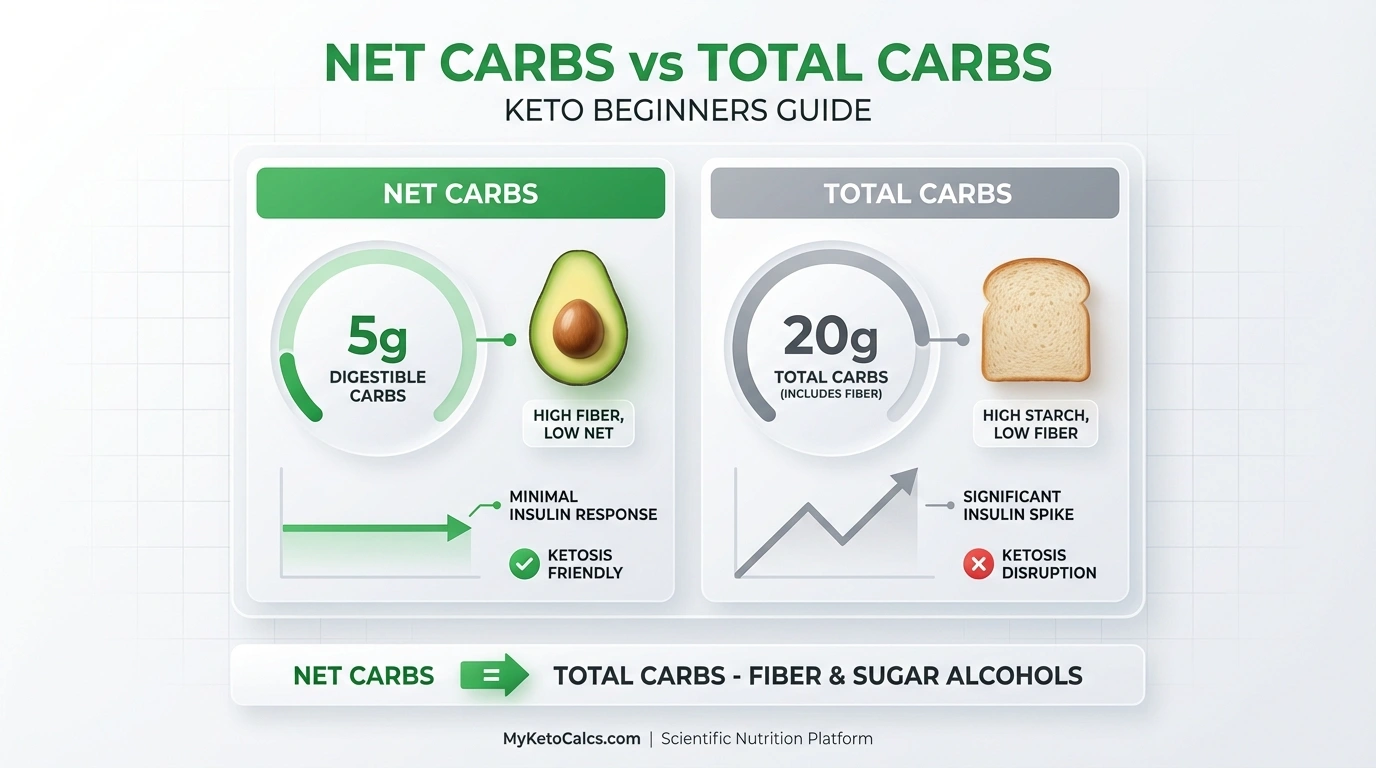
For most people following keto, tracking net carbs is the more practical approach. Net carbs isolate the digestible carbohydrates that directly elevate blood glucose and stimulate insulin secretion. Total carbs include non-digestible dietary fibers and specific sugar alcohols, which bypass small-intestinal absorption, have a negligible impact on blood glucose, and do not interrupt fat burning.
Executive summary
The distinction between net carbs and total carbs is rooted in human digestive physiology. Dietary carbohydrates are broken down by enzymes (salivary and pancreatic amylases) into simple sugars that trigger insulin release. However, structural plant fibers and specific sugar alcohols (polyols) lack the matching digestive enzymes needed to break them down. They pass through the gut with little or no effect on blood glucose and insulin. For people on keto, counting net carbs isolates the carbohydrates that actually matter for ketosis. Counting strict total carbs, on the other hand, often results in unnecessarily restricting prebiotic fibers from whole-food vegetables, which can affect gut health and bowel regularity during keto adaptation.
⚠️ Educational purposes only — not medical advice
This article explains how net carbs work for the general keto population. It is not a substitute for personalized dietary guidance from a qualified healthcare provider.
Speak with your healthcare provider before making major dietary changes if you: have type 1 or type 2 diabetes or use insulin or glucose-lowering medication (net carb counting affects blood glucose differently when medication is involved); are pregnant or breastfeeding; have kidney disease or impaired kidney function; or have a history of eating disorders. People managing diabetes should not use general net carb formulas to adjust insulin doses — consult your diabetes care team for personalized carbohydrate targets.
Net carbs vs. total carbs: the science
Not all carbohydrates affect your body the same way. In the keto framework, the goal is to keep insulin low enough that the liver produces ketones from fat. To predict how much a food will affect blood glucose, we separate carbohydrates that are fully digested and absorbed from those that pass through the digestive tract without being converted to glucose.
The physiology of carbohydrate digestion
To understand the total carbs vs. net carbs question for keto, it helps to follow the journey of carbohydrates through the gastrointestinal tract.
How blood glucose, insulin, and ketones respond
When digestible, simple carbohydrates are ingested, salivary amylase initiates enzymatic breakdown in the mouth. This process pauses in the acidic environment of the stomach and resumes in the small intestine, where pancreatic amylase and brush-border enzymes hydrolyze complex starch chains into individual monosaccharides, such as glucose. This rapid influx of glucose into the bloodstream triggers an acute release of insulin from the pancreatic beta cells. Elevated insulin signals the body to prioritize glucose for cellular energy, convert excess glucose into stored fat, and halt fat breakdown and ketone production.
Practical keto use
Maintaining nutritional ketosis typically requires keeping digestible carbohydrates around 20 to 50 grams per day. Using net carbs allows you to hit these targets while still eating plenty of non-starchy, fibrous vegetables.
What to avoid
Highly refined simple carbohydrates and starches are the carbs most likely to disrupt ketosis. They are rapidly absorbed and produce a large insulin spike that stops ketone production.
Edge cases (portion size & variability)
Hidden carbohydrates in sauces, marinades, and ultra-processed foods can accumulate quickly. Individual insulin sensitivity also matters: someone with insulin resistance may leave ketosis at a lower carb intake than someone with high insulin sensitivity.
Fiber classifications: soluble vs. insoluble
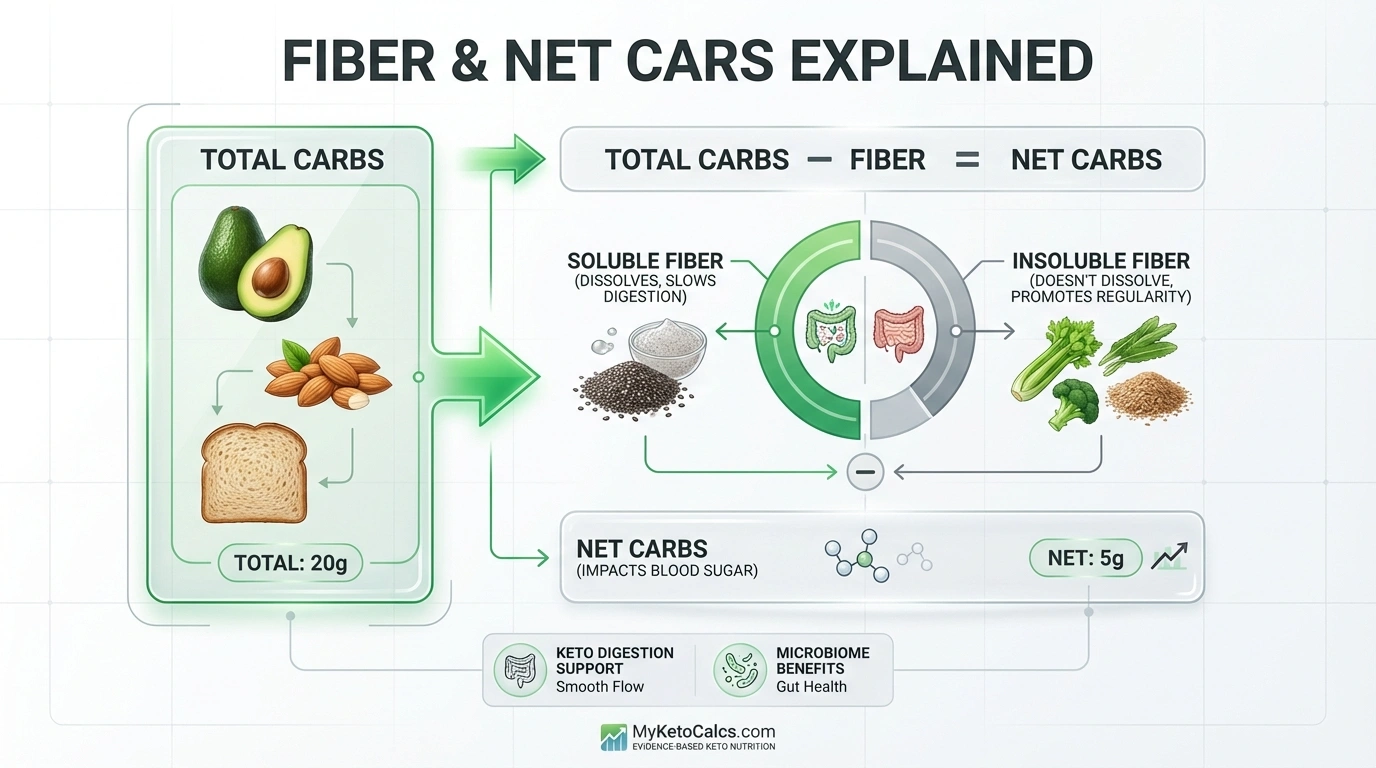
Key insight: All dietary fiber — both soluble and insoluble — can be subtracted in full when calculating net carbs. Fiber does not raise blood glucose or trigger insulin because the human digestive system lacks the enzymes to break it down. This is why high-fiber vegetables like broccoli and leafy greens have a very low net carb count.
Dietary fiber represents a broad category of complex carbohydrates that fundamentally alter the net carb calculation.
How blood glucose, insulin, and ketones respond
Fiber consists of structural plant polysaccharides. Because the human genome does not encode the digestive enzymes required to break the specific glycosidic bonds of these molecules, fiber cannot be hydrolyzed into glucose in the small intestine. Consequently, fiber passes into the large intestine undigested, yielding zero impact on blood glucose and zero stimulation of insulin.
- Soluble fiber: dissolves in water to form a highly viscous gel in the gastrointestinal tract. This gel delays gastric emptying, blunts the absorption of co-ingested macronutrients, and helps smooth out blood glucose curves.
- Insoluble fiber: does not dissolve in water. It acts as a bulking agent, accelerating intestinal transit time and maintaining bowel regularity.
Practical keto use
Adequate fiber intake is important during keto adaptation. As the body excretes sodium and water due to lowered insulin levels, constipation and electrolyte imbalances can occur. Insoluble fiber aids motility, while soluble fiber helps with water retention in the bowel.
Why fiber is always subtracted
Fiber should be a daily part of a healthy keto diet. Upon reaching the colon, gut microbiota ferment soluble fiber into short-chain fatty acids (SCFAs), such as butyrate, acetate, and propionate. SCFAs provide a direct, non-glycemic energy source for the cells lining the colon and have anti-inflammatory effects.
Edge cases (hidden carbs & adaptation)
Consuming extreme quantities of isolated functional fibers (like inulin or chicory root) found in processed “keto” foods can cause severe osmotic shifts, resulting in flatulence, bloating, and diarrhea.
Sugar alcohols (polyols): the zero-sugar variable
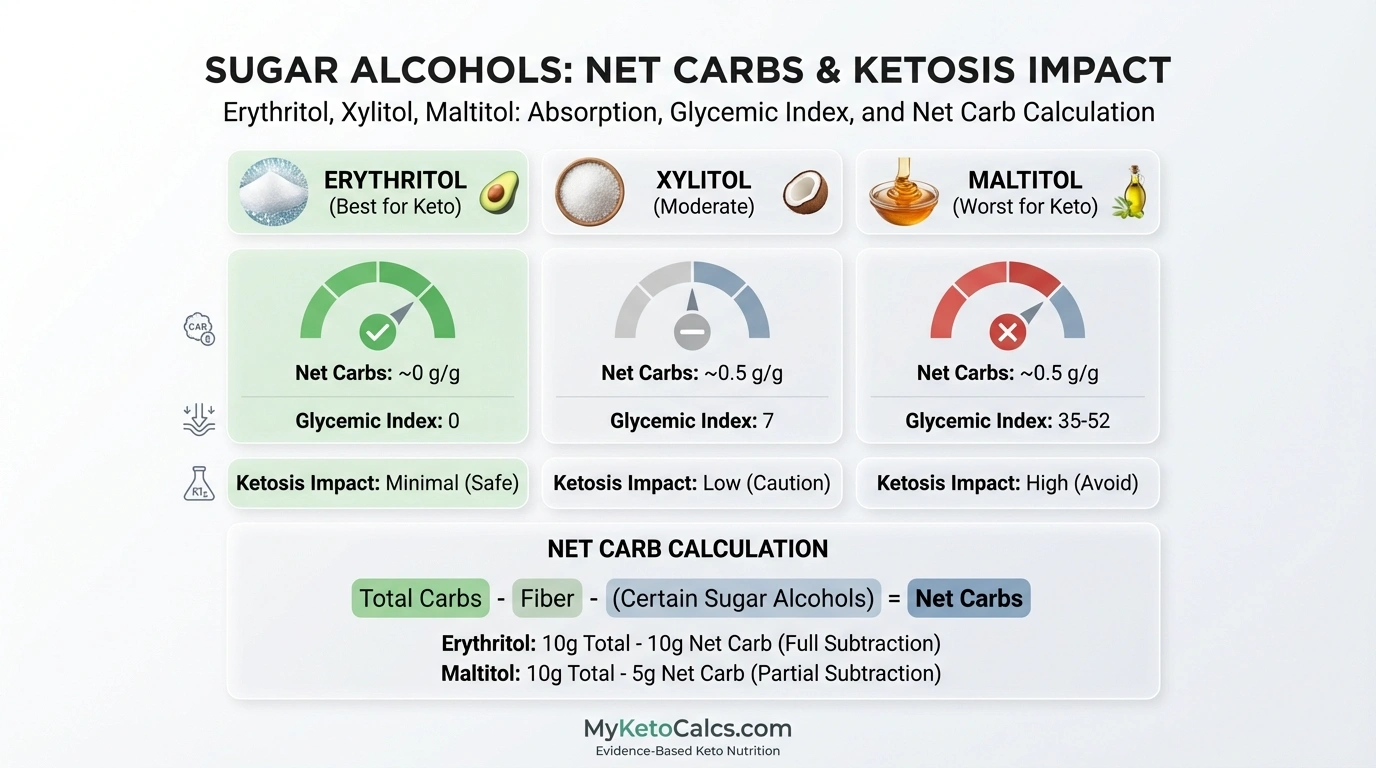
Key insight: Not all sugar alcohols are equal for keto. Erythritol and allulose are fully subtracted (GI of 0). Maltitol, xylitol, and sorbitol are only subtracted at 50% because they are partially absorbed and converted to glucose. Products labelled “zero sugar” that use maltitol can still spike blood glucose.
Sugar alcohols, or polyols, complicate the net carb landscape. Structurally resembling both sugars and alcohol, they provide sweetening properties with varying degrees of intestinal absorption.
How blood glucose, insulin, and ketones respond
The metabolic impact of a sugar alcohol is dictated entirely by its molecular size and absorption rate.
- Erythritol: a small molecule that is roughly 90% absorbed in the small intestine but cannot be metabolized by human tissue. It circulates in the bloodstream and is excreted completely unchanged in the urine within 24 hours. It has a Glycemic Index (GI) of 0 and an Insulin Index of 2.
- Xylitol: absorbed more slowly (around 50%). It is metabolized independently of insulin but still carries a minor Glycemic Index of 13 and an Insulin Index of 11.
- Maltitol: one of the most highly absorbed polyols (40% to 60% absorption). Once absorbed, it is actively converted into glucose by the liver. Maltitol has a high Glycemic Index of 35 and an Insulin Index of 27, meaning it will trigger an insulin response and disrupt ketosis.
Practical keto use
Erythritol is generally the best choice for keto products due to its metabolic inertness. Maltitol should be approached with extreme caution, as products labeled “zero sugar” using maltitol will still induce a postprandial glucose spike.
Note for people managing diabetes: If you use insulin or glucose-lowering medication, net carb counting for keto is not the same as the carbohydrate counting used to calculate insulin doses. Your diabetes care team may use total carbs or a different method. Do not use the net carb formulas on this page to adjust insulin or medication without consulting your healthcare provider.
Why some polyols are only subtracted at 50%
Because maltitol and sorbitol are partially metabolized into glucose, their presence must be accounted for. While erythritol can be fully subtracted from a total carbohydrate count, standard net carb guidance recommends subtracting only half (50%) of the grams of maltitol or sorbitol to reflect their partial glycemic impact.
Edge cases (GI distress)
The unabsorbed fraction of sugar alcohols passes into the colon, where bacterial fermentation produces significant gas and draws in water osmotically. Overconsumption of maltitol or sorbitol reliably induces strong laxative effects and gastrointestinal cramping.
Keto compatibility matrix
| Item / Concept | Keto Compatibility | Metabolic Impact | Practical Recommendation |
|---|---|---|---|
| Glucose / Sucrose | Avoid | Rapid blood glucose spike, high insulin release, halts ketogenesis. | Eliminate completely to achieve metabolic adaptation. |
| Soluble Fiber | Yes | Zero glycemic impact, slows gastric emptying, fermented into SCFAs in the colon. | Consume daily to blunt glucose curves and support microbiome health. |
| Insoluble Fiber | Yes | Zero glycemic impact, acts as a bulking agent, accelerates transit time. | Consume daily to prevent common keto-induced constipation. |
| Erythritol (Polyol) | Yes | 90% absorbed, excreted unchanged in urine; GI of 0, Insulin Index of 2. | Generally the best non-nutritive sweetener; subtract 100% from total carbs. |
| Maltitol (Polyol) | Limit / Avoid | 40–60% absorbed, converted to glucose hepatically; GI of 35, Insulin Index of 27. | Avoid; if consumed, subtract only 50% of its grams when calculating net carbs. |
| Xylitol (Polyol) | Limit | 50% absorbed, metabolized without insulin; GI of 13, Insulin Index of 11. | Use sparingly due to its moderate GI; highly toxic to canines. |
| Allulose (Rare Sugar) | Yes | Not metabolized or absorbed; zero glycemic impact. | Safe alternative; can be fully subtracted from total carbohydrate counts. |
Keto net carbs calculator tool & formula
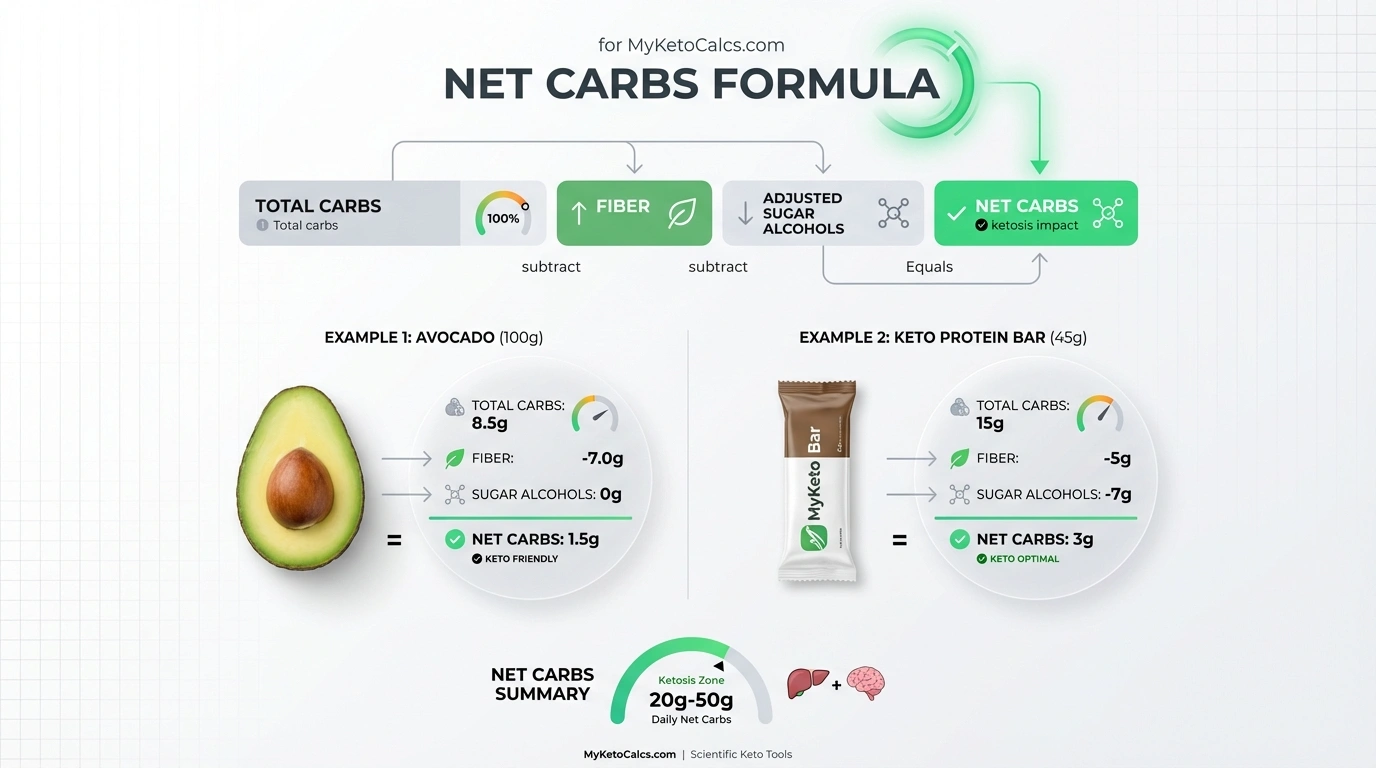
Key insight: Net Carbs = Total Carbohydrates − Dietary Fiber − Qualifying Sugar Alcohols. Subtract fiber at 100%. Subtract erythritol and allulose at 100%. Subtract maltitol, xylitol, sorbitol, and isomalt at 50% only. The result tells you how many grams of carbohydrate will actually affect your blood glucose.
The standard way to calculate net carbs is to isolate the carbohydrate fractions that are actually digested and absorbed. The widely accepted net carbs formula is:
The net carbs formula
Net Carbs = Total Carbohydrates – Dietary Fiber – Sugar AlcoholsTo apply this formula accurately, use the absorption rules:
- Input total carbohydrates: the full carbohydrate count from the nutrition label.
- Input dietary fiber: the sum of soluble and insoluble fibers. Because the human gut lacks the enzymes to break these bonds, this value is subtracted entirely.
- Input sugar alcohols (adjusted): if the product uses erythritol or allulose, 100% of these grams may be subtracted. If the product contains maltitol, sorbitol, xylitol, or isomalt, only 50% of these grams should be subtracted to account for their partial conversion to glucose.
- Output: the resulting net carb number represents the carbohydrates that will actually affect blood glucose and ketosis.
👇 Calculate Your Keto Macros
Apply net carb logic inside a complete keto macro framework. Know your daily fat, protein, and carb targets — not just your net carb ceiling.
Your Personalized Results
Daily Target
0
kcal / day
Real-world label examples: applying the formula
Applying this formula to real-world label reading shows why the choice between total carbs and net carbs matters in practice.
Case study 1: whole food matrix (avocado)
An average medium avocado contains 17.1g of total carbohydrates. However, 13.5g of this consists of dietary fiber.
Calculation: 17.1g (Total) − 13.5g (Fiber) = 3.6g Net Carbs.
What this means: the high concentration of viscous soluble fiber severely blunts the enzymatic access to the remaining 3.6g of digestible carbohydrates. The resulting glucose rise is practically undetectable, making the avocado an excellent fat-adapted food source despite its high total carbohydrate count.
Case study 2: processed “keto” protein bar
A commercially available sugar-free protein bar claims to be keto-friendly. Its nutrition panel lists 23g Total Carbohydrates, 9g Fiber, and 11g Sugar Alcohols (specifically maltitol).
Calculation: if a consumer blindly subtracts the total polyol count, they assume the bar has 3g of net carbs (23 − 9 − 11 = 3). However, applying the correct 50% rule, maltitol is partially glycemic. We subtract the 9g of fiber, but only half (5.5g) of the maltitol.
What this means: 23g (Total) − 9g (Fiber) − 5.5g (Maltitol 50%) = 8.5g Net Carbs. Ingesting 8.5g of rapidly digesting, high-GI polyols will acutely raise blood glucose and trigger an insulin response, potentially ending ketosis.
The total carbs vs. net carbs debate
A recurring debate among keto practitioners and nutrition educators questions whether people should count total carbs instead of net carbs. The contrarian argument points out that because colonic bacteria ferment fiber into short-chain fatty acids, which yield approximately 1.5 to 2.5 kilocalories per gram, fiber does technically provide energy to the host. Furthermore, detractors argue that promoting “net carbs” creates a dietary loophole, encouraging the overconsumption of ultra-processed “keto junk foods” engineered with synthetic fibers and polyols that mimic the hyper-palatability of the standard Western diet.
While it is factually correct that massive quantities of artificial fibers can lead to a caloric surplus and significant gastrointestinal distress, defaulting to a strict “total carb” limit is not the best framework for managing ketosis. The primary physiological marker for ketogenesis is the suppression of insulin. Because dietary fiber does not elevate blood glucose or trigger pancreatic insulin secretion, restricting it based on a gross “total carb” limit needlessly penalizes nutrient-dense, high-fiber vegetables like spinach, broccoli, and kale. Depriving the body of these whole-food fibers during keto adaptation can worsen electrolyte depletion, affect gut microbiome diversity, and impair bowel motility. The evidence-based approach for most people is to track net carbs, provided the majority of those carbohydrates come from whole, unprocessed plants rather than synthetic sugar alcohols.
Frequently asked questions
Do net carbs actually matter for ketosis?
Yes, tracking net carbs is the most accurate method for maintaining ketosis. Ketogenesis is regulated by insulin suppression, and only digestible carbohydrates trigger significant insulin release. Because fiber and specific sugar alcohols pass through the upper gastrointestinal tract without being converted into glucose, they do not disrupt the liver’s production of ketone bodies.
Why is the FDA against the term net carbs?
The FDA does not legally recognize or define the term “net carbs” for nutritional labeling purposes. The FDA strictly regulates the reporting of Total Carbohydrates, Dietary Fiber, and Sugars. Because “net carbs” is largely a marketing term utilized by food manufacturers, its calculation can be manipulated to obscure the true glycemic impact of a product.
Does maltitol kick you out of ketosis?
Maltitol has a high likelihood of interrupting ketosis, depending on the dosage consumed. Unlike erythritol, maltitol is absorbed efficiently in the small intestine and converted into glucose by the liver. With a Glycemic Index of 35 and an Insulin Index of 27, maltitol directly elevates blood glucose and triggers an insulin response. For the distinction between nutritional ketosis and diabetic ketoacidosis, see ketosis vs. ketoacidosis explained.
How do I calculate net carbs with sugar alcohols?
To calculate net carbs accurately, subtract total dietary fiber from the total carbohydrate count. For sugar alcohols, subtract 100% of the grams of erythritol. For all other sugar alcohols, such as maltitol, xylitol, and sorbitol, subtract only 50% of their gram weight to account for their partial intestinal absorption and glycemic impact.
Do I count total carbs or net carbs for vegetables?
You should track net carbs when consuming vegetables. Non-starchy vegetables like broccoli and leafy greens contain a high proportion of insoluble and soluble fiber. Because this fiber cannot be digested into glucose, counting total carbs would needlessly restrict your intake of vital micronutrients, electrolytes, and antioxidants — the opposite of what you need to maintain nutritional ketosis.
What are short-chain fatty acids (SCFAs)?
Short-chain fatty acids are the byproducts created when beneficial gut bacteria ferment soluble dietary fiber in the colon. Common SCFAs include butyrate, propionate, and acetate. They provide a direct energy source for the cells lining the colon, promote a healthy gut microbiome, and do not raise systemic blood sugar.
Is allulose treated like a sugar alcohol?
Allulose is functionally similar to a sugar alcohol in terms of carb counting, but structurally it is a “rare sugar” found in nature. The human body does not possess the enzymes to metabolize allulose, meaning it is excreted without impacting blood glucose or insulin. Therefore, 100% of allulose carbohydrates can be subtracted when calculating net carbs.
Can too much fiber cause problems on keto?
While fiber is beneficial, introducing massive amounts of isolated, functional fibers (like chicory root or inulin) found in processed keto foods can overwhelm the digestive system. Because these fibers are fermented rapidly by gut bacteria, overconsumption routinely causes severe bloating, flatulence, osmotic diarrhea, and abdominal cramping.
Does fiber cancel out other carbohydrates?
No, dietary fiber does not “cancel out” or erase the metabolic impact of simple sugars or starches co-ingested in the same meal. While soluble fiber forms a gel that can slow the overall rate of digestion and blunt the peak of a glucose spike, the digestible carbohydrates will eventually be absorbed and trigger an insulin response.
Why do some professionals recommend counting total carbs?
Some professionals recommend tracking total carbs because it simplifies the diet and restricts the consumption of hyper-processed “keto junk foods.” By forcing individuals to track total carbs, dieters naturally eliminate products laden with artificial sweeteners and synthetic fibers, ensuring their restricted carbohydrate allotment comes exclusively from nutrient-dense whole foods.
Conclusion: Track What Affects Your Blood Glucose
Net carbs are not a loophole — they are a more accurate way to count the carbohydrates that actually raise blood glucose and affect ketosis. By subtracting dietary fiber and qualifying sugar alcohols, you identify the carbs that matter for keeping insulin low and fat-burning active.
The core rules are simple: subtract all fiber, subtract erythritol and allulose in full, and subtract maltitol and similar polyols at only 50%. Source your net carbs from whole foods — vegetables, nuts, and dairy — not from processed products engineered with high-GI sugar alcohols.
If you want to understand how your body confirms it is in ketosis, the guide to measuring ketosis with blood, urine, and breath testing covers all methods in full. And if you have just come back from a carb-heavy break, the getting back into ketosis guide walks through the recovery protocol step by step.
Data & Sources
This article draws on established research in carbohydrate physiology, glycemic index science, and ketogenic nutrition. Key quantitative claims are listed below with their basis. MyKetoCalcs is an educational site, not a medical provider. For clinical decisions, consult your healthcare provider.
- Fiber is not digested into glucose: The human genome does not encode the enzymes required to break the beta-glycosidic bonds of structural plant polysaccharides (cellulose, pectin, hemicellulose). This is established in human digestive physiology. Fiber therefore yields zero net glucose and zero insulin stimulus.
- Erythritol Glycemic Index = 0, Insulin Index ≈ 2: Erythritol is approximately 90% absorbed in the small intestine but cannot be metabolized by human tissue; it is excreted unchanged in urine. GI and II values sourced from published Glycemic Index and Insulin Index databases and referenced in diabetes nutrition research (see beyondtype1.org link below).
- Maltitol Glycemic Index = 35, Insulin Index = 27: Maltitol is 40–60% absorbed and converted to glucose hepatically. GI and II values are from published polyol absorption research and dietary sugar substitute literature. The 50% subtraction rule reflects this partial absorption rate.
- FDA does not legally define “net carbs”: The FDA regulates nutritional labels to report Total Carbohydrates, Dietary Fiber, and Sugars. “Net carbs” is not an FDA-defined term and may be calculated inconsistently by food manufacturers. Source: U.S. FDA nutrition labeling regulations (diabetes.org reference below).
- Fiber yields ~1.5–2.5 kcal/g via colonic fermentation: Soluble fiber is fermented by gut bacteria into short-chain fatty acids (butyrate, acetate, propionate), providing indirect caloric value. This does not affect blood glucose or insulin, but is acknowledged in the contrarian analysis section. Based on established nutritional energy values for fermentable fiber.
Verified external references (from source HTML): Beyond Type 1: Net Carbs & Sweeteners | American Diabetes Association: Understanding Carbs
Further Reading & Tools
Explore More Resources
For additional information, explore these resources on carbohydrate metabolism and net carb counting: