
Carbs in Spinach per 100g & per Cup: Is Spinach Keto?
Carbs in spinach are very low: raw spinach has just 0.4g net carbs per cup and 1.4g per 100g — making it one of the most keto-friendly vegetables available at any serving size.
Carbs in Spinach: Quick Answer
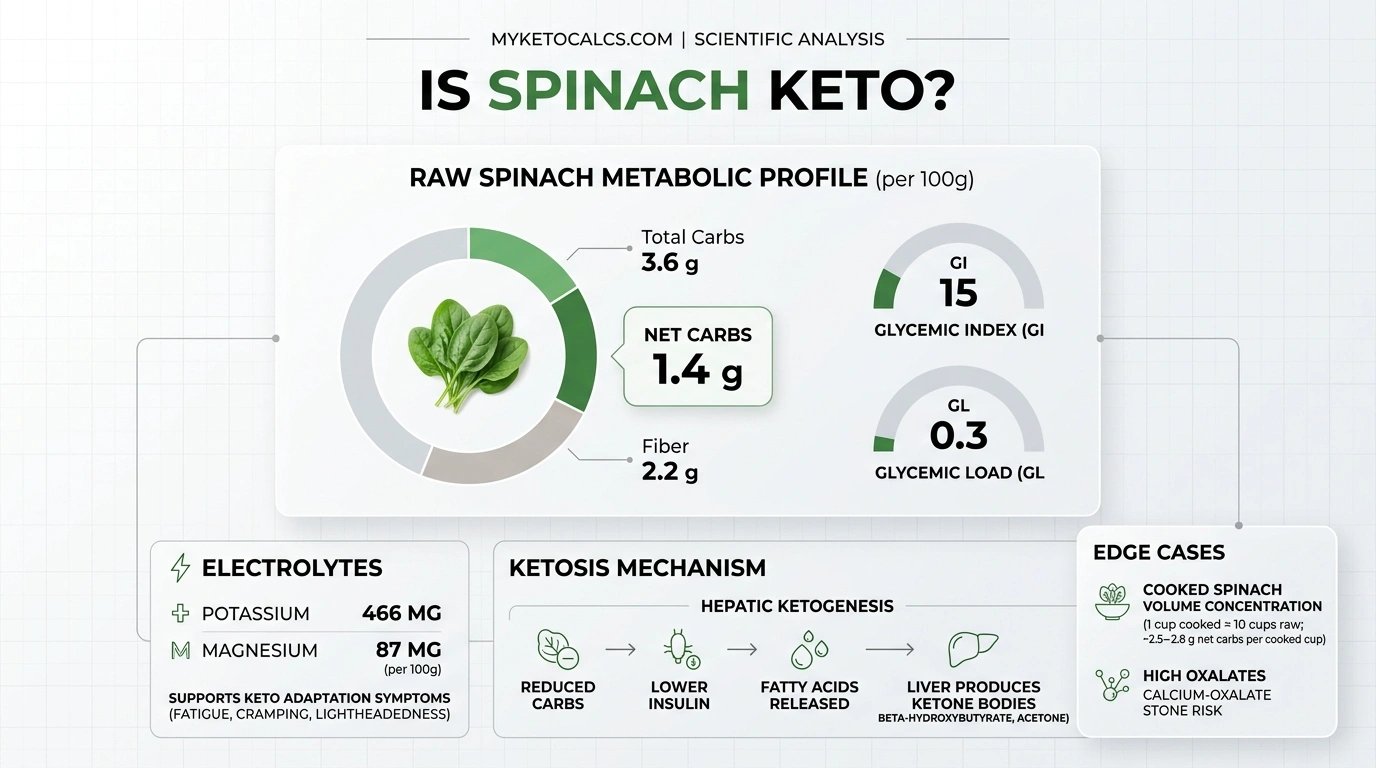
Carbs in spinach are minimal: 100g of raw spinach has 3.6g total carbs and 2.2g fiber, so just 1.4g net carbs. Yes — spinach is fully keto-friendly. Raw spinach contains approximately 0.4g net carbs per cup and 1.4g net carbs per 100g, with a glycemic index of 15 and a glycemic load of 0.3. It does not provoke an insulin response that would disrupt ketosis. You can eat spinach daily on keto without concern about carb accumulation from this vegetable alone.
Spinach contains 3.6g total carbohydrates and 2.2g fiber per 100g raw. At roughly 30g per raw cup, a single cup contributes only 0.4g net carbs — negligible against a standard 20–50g daily keto budget. Even a 3-cup salad base adds just 1.2g net carbs. The net carbs table below breaks this down by serving type, cooking method, and spinach form.
How Many Carbs in Spinach? Raw, Cooked, Baby & Frozen
The table below compares spinach net carbs across all common serving sizes and preparation methods. Track by grams, not cups, for the most accurate keto carb counting. Values are approximate and based on USDA FoodData Central reference data as used throughout this analysis.
| Spinach Type | Typical Serving | Total Carbs | Fiber | Net Carbs | Keto Verdict | Practical Use |
|---|---|---|---|---|---|---|
| Raw spinach | 1 cup (~30g) | ~1.1g | ~0.7g | ~0.4g | ✅ Optimal | Daily salad base — eat freely |
| Raw spinach | 100g | 3.6g | 2.2g | 1.4g | ✅ Optimal | Standard tracking reference |
| Baby spinach | 1 cup (~30g) | ~1.1g | ~0.7g | ~0.4g | ✅ Optimal | Nutritionally identical to raw — milder flavor |
| Cooked spinach | 1 cup (~180g) | ~6.7g | ~4.3g | ~2.4g | ✅ Yes — monitor portion | Sautéed in butter, omelets, soups |
| Cooked spinach | 100g | ~3.8g | ~2.4g | ~1.4g | ✅ Optimal | Same as raw per gram of weight |
| Frozen spinach, thawed | 1 cup (~175g) | ~6.4g | ~4.0g | ~2.4g | ✅ Yes — monitor portion | Convenient alternative to fresh cooked |
Approximate values based on USDA FoodData Central data. Cooked spinach values reflect boiled or sautéed and drained preparation. Net carbs = total carbohydrates − dietary fiber.
Spinach Net Carbs: Raw vs Cooked — What Changes?
Short answer: Per 100g, raw and cooked spinach have essentially the same net carbs (~1.4g). Per cup, cooked spinach has roughly 8 times more net carbs than raw, because cooking removes water and concentrates the plant matter. Track spinach by grams, not cups, for accurate keto carb counting.
The question “does cooking increase spinach carbs?” requires two separate answers depending on how you measure:
- Per 100g (by weight): No. Raw spinach and cooked spinach have approximately 1.4g net carbs per 100g in both states. The carbohydrates per gram of plant matter do not change with cooking.
- Per cup (by volume): Yes — significantly. A raw cup of spinach weighs roughly 30g, giving approximately 0.4g net carbs. A cup of cooked spinach weighs approximately 180g because the water has been removed, compressing around six times the plant matter into the same volume. That cooked cup contains approximately 2.4g net carbs.
The practical rule: Track spinach in grams, not cups. If you weigh 100g of spinach raw and cook it, your net carbs remain approximately 1.4g — regardless of how much it shrinks on the plate. Tracking by cups after cooking will dramatically undercount carbs for cooked preparations.
How Much Spinach Can You Eat on Keto Per Day?
Short answer: More than you will realistically eat. On a 20g daily net carb limit, you could eat approximately 1,400g (around 47 raw cups) of spinach before hitting your limit. In practice, 3–4 cups of raw spinach daily adds under 2g net carbs — a negligible portion of any daily keto budget.
At 1.4g net carbs per 100g, a 20g daily net carb limit allows for approximately 1,400g of raw spinach. That is roughly 47 raw cups — far beyond any practical meal plan. Spinach is one of the rare vegetables where quantity is never the keto concern.
Realistic daily spinach quantities and their carb cost against a 20g limit:
- 1 cup raw spinach (30g): ~0.4g net carbs — leaves 19.6g remaining
- 2 cups raw spinach (60g): ~0.8g net carbs — leaves 19.2g remaining
- 3-cup salad base (90g): ~1.3g net carbs — leaves 18.7g remaining
- 1 cup cooked spinach (180g): ~2.4g net carbs — leaves 17.6g remaining
- 2 cups cooked spinach (360g): ~4.8g net carbs — still within a 20g budget, but worth tracking
The edge case: Cooked spinach in large quantities does accumulate carbs meaningfully. Dishes like creamed spinach with 2–3 cups cooked can use 6–10g of net carbs before accounting for cream, cheese, or other ingredients. Track the cooked weight using 100g = ~1.4g net carbs as your anchor.
For a complete picture of how spinach fits into your daily carb budget alongside other vegetables and meals, see the guide to net carbs vs total carbs on keto.
Is Spinach High in Carbs Compared to Other Keto Vegetables?
Short answer: No — spinach is among the lowest-carb vegetables at 1.4g net carbs per 100g. It far outperforms broccoli (4.0g), cauliflower (3.0g), and kale (5.2g). Only celery and some lettuces come close to spinach’s low carb density.
Spinach consistently ranks at the top of any keto vegetable list, not just as a carb-safe choice but as a nutritional standout for electrolyte content. For comparison:
| Vegetable | Net Carbs per 100g | vs Spinach | Keto Verdict |
|---|---|---|---|
| Spinach | 1.4g | — | ✅ Optimal |
| Celery | ~1.4g | Equal | ✅ Optimal |
| Iceberg lettuce | ~1.6g | +0.2g | ✅ Optimal |
| Arugula (rocket) | ~2.0g | +0.6g | ✅ Optimal |
| Swiss chard | ~2.1g | +0.7g | ✅ Yes |
| Romaine lettuce | ~2.0g | +0.6g | ✅ Optimal |
| Cauliflower | ~3.0g | +1.6g | ✅ Yes |
| Broccoli | ~4.0g | +2.6g | ✅ Yes — moderate |
| Kale | ~5.2g | +3.8g | ⚠️ Limit portions |
| Brussels sprouts | ~5.0g | +3.6g | ⚠️ Limit portions |
For a fully ranked list of keto vegetables by net carbohydrate content, see the best low-carb vegetables for keto and the complete keto vegetables list.
Methodology: nutritional database logic and glycemic principles
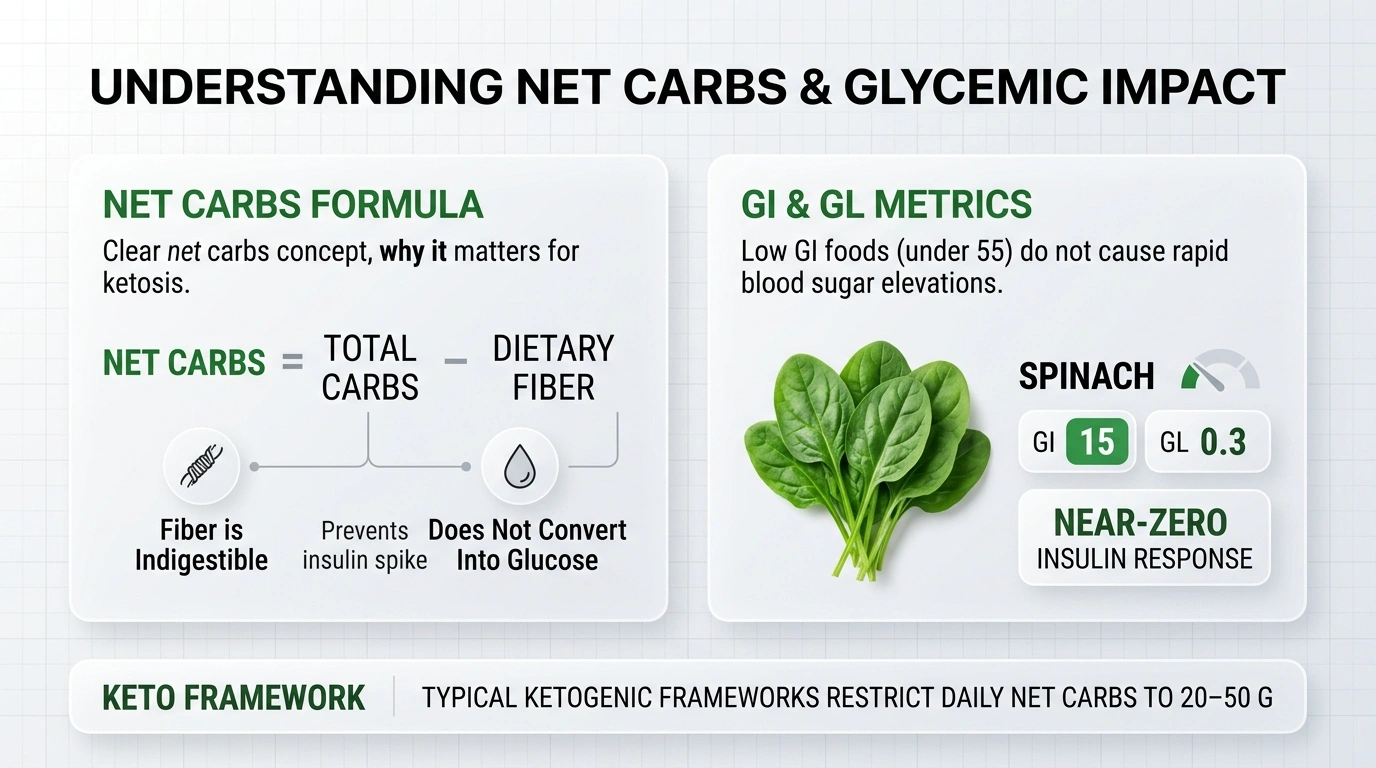
To determine keto compatibility, this analysis relies on the concept of net carbohydrates, which is calculated by subtracting indigestible dietary fiber from total carbohydrates. Because the human gastrointestinal tract lacks the enzymes to break down dietary fiber, it does not convert into glucose, thereby bypassing the bloodstream and preventing an insulin spike.
The glycemic index (GI) and glycemic load (GL) are also critical metrics. Foods with a low GI (under 55) do not cause rapid elevations in blood sugar. Spinach, for example, has a GI of 15 and a GL of 0.3, indicating a near-zero impact on the body’s insulin response. By cross-referencing these glycemic principles with standard ketogenic frameworks (which typically restrict daily net carbs to 20–50 grams), we can objectively classify vegetation.
Scientific deep dive: ketosis mechanisms and keto adaptation
When carbohydrate intake is severely restricted, the body’s glucose reserves deplete, leading to a concurrent drop in serum insulin. This state of hypoinsulinemia signals adipocytes to release stored fatty acids, which travel to the liver and are converted into ketone bodies (acetoacetate, beta-hydroxybutyrate, and acetone) via hepatic ketogenesis.
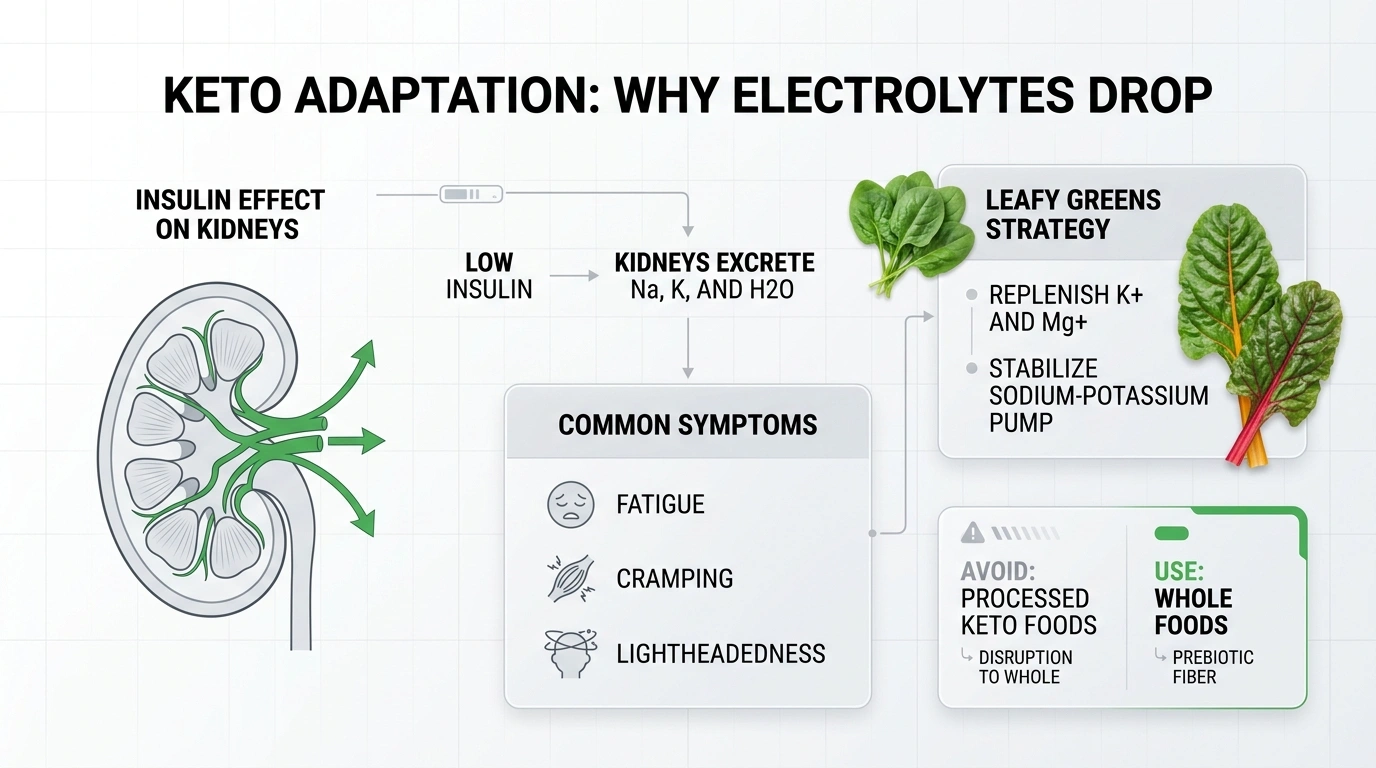
During the initial phase of keto adaptation (often associated with the “keto flu”), the drop in insulin causes the kidneys to rapidly excrete sodium, potassium, and water. This is where the integration of a precise keto vegetables list becomes biochemically vital. Leafy greens keto strategies rely on vegetables like spinach and Swiss chard to replenish intracellular potassium and magnesium, stabilizing the sodium-potassium pump and alleviating fatigue, cramping, and lightheadedness.
Furthermore, while “zero sugar” ultra-processed keto foods can occasionally trigger a cephalic phase insulin response or disrupt the gut microbiome, whole-food leafy greens provide prebiotic fiber that ferments into short-chain fatty acids (SCFAs) without elevating blood glucose.
Contrarian analysis: debunking common keto myths
Myth 1: Cooking increases the carbohydrate content of vegetables.
Scientific logic refutes this. The absolute carbohydrate content per 100 grams of spinach remains identical whether raw or cooked. However, cooking depletes water content, reducing the physical volume. Thus, one cup of cooked spinach contains significantly more plant matter—and therefore more total carbohydrates—than one cup of raw spinach.
Myth 2: All vegetables are “free foods” on keto.
While fiber-rich, vegetables are not metabolically “free.” Starchy, below-ground vegetables like potatoes and carrots contain high levels of digestible starch that rapidly convert to glucose, halting ketone production. Even among above-ground vegetables, continuous overconsumption of moderate-carb greens (like kale or Brussels sprouts) can stealthily push a dieter over the 50-gram daily threshold.
Rapid data matrix: keto greens
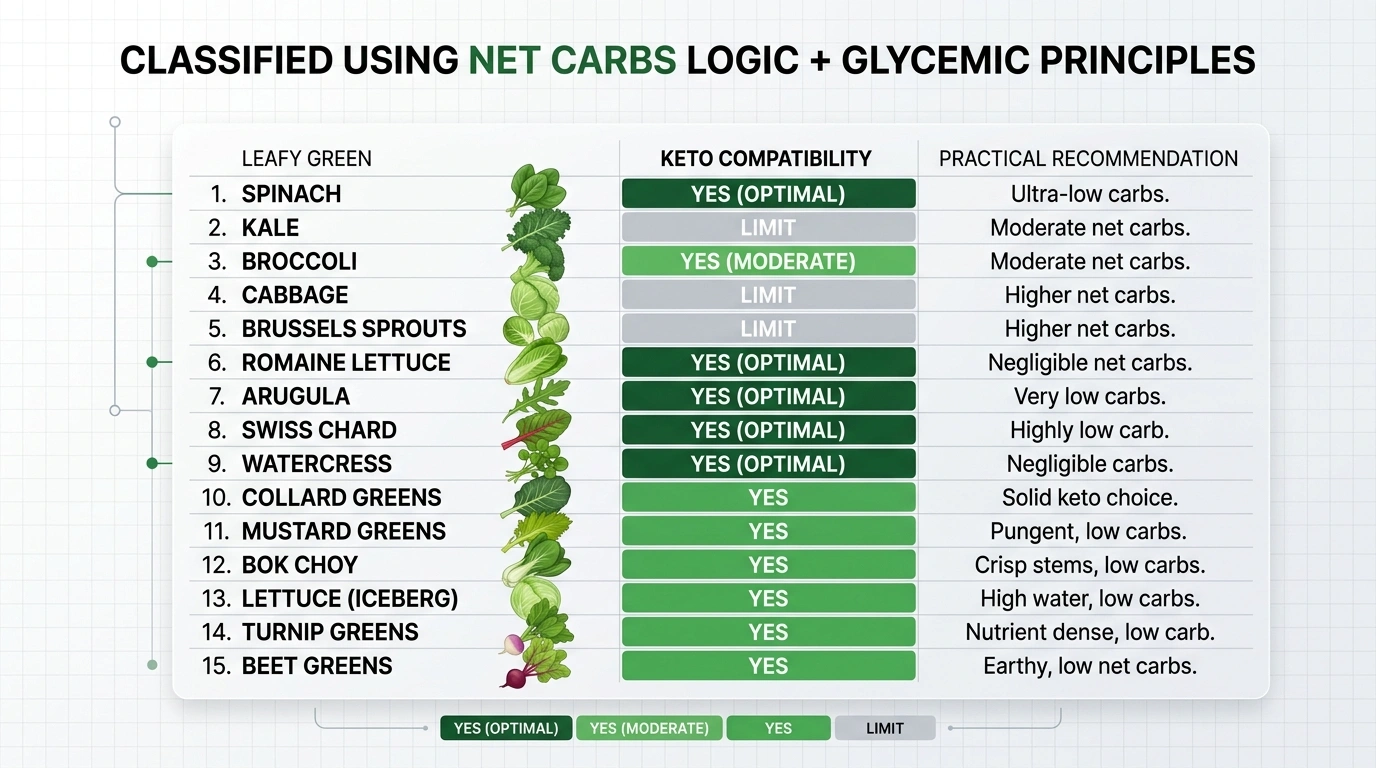
The table below provides a comprehensive compatibility overview for 15 leafy greens and vegetables commonly used on a ketogenic diet, including their metabolic impact and practical recommendations.
| Item / Concept | Keto Compatibility | Metabolic Impact | Practical Recommendation |
|---|---|---|---|
| Spinach | Yes (Optimal) | Negligible insulin response; high electrolyte yield. | Consume daily; monitor volume if cooked. |
| Iceberg Lettuce | Yes | High hydration; zero glycemic impact. | Use as carb-free wraps or salad bases. |
| Romaine Lettuce | Yes | Low glycemic load; moderate micronutrients. | Excellent for daily volume eating. |
| Kale | Limit | Moderate starch content; potential carb accumulation. | Restrict to 1/2 cup raw portions. |
| Swiss Chard | Yes | High potassium; excellent for keto adaptation. | Sauté in healthy fats to aid absorption. |
| Arugula (Rocket) | Yes | Nitrate-rich; supports vasodilation. | Use raw as a peppery base for proteins. |
| Cabbage (Green/Red) | Limit | Fermentable fiber; moderate net carbs. | Monitor portions; ideal for gut health. |
| Bok Choy | Yes | Very low carb; high vitamin K. | Optimal for keto-friendly stir-fries. |
| Brussels Sprouts | Limit | Higher net carbs; contains alpha-lipoic acid. | Weigh portions strictly; roast in fats. |
| Broccoli | Yes (Moderate) | Sulforaphane-rich; low glycemic impact. | Excellent pasta/rice substitute. |
| Zucchini | Yes | High water content; very low net carbs. | Spiralize as a pasta replacement. |
| Asparagus | Yes | Diuretic properties; low carb. | Pair with hollandaise for high-fat macros. |
| Endive | Yes | Extremely low carb; bitter prebiotic. | Use as a dipping vessel for high-fat sauces. |
| Radicchio | Yes | Negligible carbs; high antioxidants. | Mix into salads for metabolic diversity. |
| Celery | Yes | Near-zero net carbs; provides crunch. | Use to transport high-fat dips and cheeses. |
Deep dive: individual green profiles
Below is a detailed metabolic analysis of each leafy green, including biochemical justification, practical use, and edge cases specific to ketogenic dieters.
Is spinach keto?
Metabolic Profile: raw spinach contains 3.6 grams of total carbohydrates and 2.2 grams of fiber per 100 grams, yielding just 1.4 grams of net carbohydrates. It has a glycemic index of 15 and a glycemic load of 0.3.
Practical Keto Use: spinach serves as a highly versatile foundation for a ketogenic diet. It can be consumed raw in large-volume salads, blended into low-carb smoothies, or wilted into eggs and heavy cream.
Biochemical Justification (Always): due to its extraordinarily low net carbohydrate yield, spinach will not disrupt hepatic ketogenesis. Furthermore, it provides 466 mg of potassium and 87 mg of magnesium per 100 grams, making it biochemically essential for managing the electrolyte excretion associated with suppressed insulin levels during ketosis. See the keto electrolytes and hydration guide for a full electrolyte protocol during keto adaptation.
Edge Cases: because cooking drastically reduces its volume, 1 cup of cooked spinach represents approximately 6 cups of raw spinach by weight, bringing the net carb count to roughly 2.4 grams per cup. Additionally, spinach is high in oxalates, which may bind to calcium and present an edge-case risk for individuals prone to calcium-oxalate kidney stones.
Is lettuce keto? (Romaine)
Metabolic Profile: romaine lettuce contains approximately 3.5 grams of total carbohydrates and 1.5 grams of fiber per 100 grams, resulting in 2.0 grams of net carbs.
Practical Keto Use: with its rigid structure, Romaine is the optimal substitute for high-carb bread. It is frequently utilized in keto nutrition as a wrap for high-fat meats, cheeses, and mayonnaise-based salads.
Biochemical Justification (Always): romaine is predominantly water (over 94%), meaning it provides physical gastric distension (satiety) with almost zero metabolic penalty. It elicits no significant insulin response.
Edge Cases: while highly compatible with keto, Romaine lacks the dense micronutrient profile of darker greens like spinach. Relying solely on Romaine may leave a keto dieter short on essential potassium.
Is iceberg lettuce keto?
Metabolic Profile: iceberg lettuce yields approximately 1.6 grams of net carbohydrates per 100 grams.
Practical Keto Use: best utilized for its crunch and hydration. It is highly effective as a carbohydrate-free vehicle for high-fat dressings like blue cheese, ranch, or olive oil.
Biochemical Justification (Always): iceberg lettuce is metabolically inert. The negligible carbohydrate content means it can be eaten in near-unlimited quantities without threatening a state of nutritional ketosis.
Edge Cases: similar to Romaine, Iceberg is nutritionally sparse compared to other leafy greens. It should be viewed as a textural component rather than a primary micronutrient source.
Is kale keto?
Metabolic Profile: kale is significantly denser than other greens, containing roughly 5.2 grams of net carbohydrates per 100 grams.
Practical Keto Use: kale must be consumed with intentional portion control. It is best prepared by massaging it with olive oil to break down the tough cellulose, or baked slowly into keto-friendly kale chips.
Biochemical Justification (Limit): while kale is rich in lutein and zeaxanthin (critical for ocular health), its higher starch and carbohydrate content means that consuming large bowls of it can easily contribute 10–15 grams of net carbs to a daily total. This requires strict tracking to prevent an accidental exit from ketosis.
Edge Cases: raw kale contains goitrogens, which can interfere with thyroid function if consumed in massive, unmeasured quantities. Cooking reduces this effect but concentrates the carbohydrates by volume.
Is swiss chard keto?
Metabolic Profile: swiss chard yields approximately 2.1 grams of net carbohydrates per 100 grams.
Practical Keto Use: due to its fibrous stalks, Swiss chard is typically sautéed in butter, ghee, or bacon fat, which perfectly aligns with the high-fat requirements of the ketogenic protocol.
Biochemical Justification (Always): swiss chard is exceptionally rich in potassium and contains kaempferol, a potent antioxidant. Its low carbohydrate profile ensures that insulin remains suppressed, allowing continuous beta-oxidation of fatty acids.
Edge Cases: like spinach, Swiss chard contains oxalates. Boiling the leaves and discarding the water can significantly reduce the oxalate load without adding carbohydrates.
👇 Establish Your Metabolic Boundaries
Even if you’re focused on leafy greens and net carbs, rely on data, not intuition. Find your personal keto macro baseline.
Your Personalized Results
Daily Target
0
kcal / day
Frequently Asked Questions: Spinach on Keto
Is spinach keto-friendly?
Yes — spinach is one of the most keto-compatible vegetables available. Raw spinach contains approximately 0.4g net carbs per cup and 1.4g per 100g, with a glycemic index of 15 and a glycemic load of 0.3. It does not provoke an insulin response that would disrupt ketosis. You can eat spinach freely in salads, smoothies, and cooked dishes on keto.
How many net carbs does spinach have per cup?
A raw cup of spinach (approximately 30g) contains roughly 0.4g net carbs. A cooked cup (approximately 180g) contains approximately 2.4g net carbs due to water loss concentrating more plant matter into the same volume. Always track by grams for accuracy — the cup measurement changes dramatically between raw and cooked forms of spinach.
How many carbs are in spinach per 100g?
Raw spinach contains 3.6g total carbohydrates and 2.2g fiber per 100g, yielding 1.4g net carbs per 100g. Cooked spinach has approximately 3.8g total carbs and 2.4g fiber per 100g — also approximately 1.4g net carbs per 100g. The difference only appears when comparing by cup volume rather than gram weight.
Does cooking spinach increase its carb count?
Per 100g, no. The net carb content per gram of spinach remains approximately 1.4g whether raw or cooked. Per cup, yes — significantly. Cooking removes water, shrinking spinach’s volume while keeping all the plant matter. One cup of cooked spinach contains roughly 180g versus 30g raw, making the cooked cup approximately 8 times higher in net carbs per cup than the raw cup.
Can I eat spinach every day on keto?
Yes. Eating 3–4 cups of raw spinach daily adds approximately 1.2–1.6g of net carbs to your budget — negligible against a 20–50g daily limit. Spinach also provides potassium (466mg per 100g) and magnesium (87mg per 100g), electrolytes commonly depleted during keto adaptation. Daily spinach consumption is actively beneficial, not just permitted. See the keto electrolytes and hydration guide for a full electrolyte protocol.
Is baby spinach the same as regular spinach for keto?
Nutritionally, yes. Baby spinach and mature spinach have virtually identical carbohydrate profiles — approximately 0.4g net carbs per raw cup and 1.4g per 100g. Baby spinach is simply a younger leaf with a milder flavor. For keto carb tracking, treat them as equivalent. Some people find baby spinach more palatable raw, which supports daily keto salad habits.
Is spinach high in carbs compared to other vegetables?
No — spinach is among the lowest-carb vegetables at 1.4g net carbs per 100g. It ranks alongside celery and below arugula (2.0g) and iceberg lettuce (1.6g). It far outperforms broccoli (4.0g), cauliflower (3.0g), and kale (5.2g). Spinach is the benchmark low-carb vegetable that most keto vegetable comparisons reference. For the full ranked list, see the best low-carb vegetables for keto.
Can you put spinach in a smoothie on keto?
Yes. Adding raw spinach to a keto smoothie is a practical strategy for micronutrient intake without meaningful carb cost. A large handful (60g) of raw spinach adds approximately 0.8g net carbs. Blend with heavy cream, full-fat Greek yogurt, avocado, or coconut cream for a macro-compliant keto smoothie base. Blending does not change spinach’s net carb content.
Why is spinach good for keto electrolytes?
Spinach provides 466mg of potassium and 87mg of magnesium per 100g raw — two of the three electrolytes most depleted during keto adaptation. When insulin drops on keto, the kidneys excrete sodium, potassium, and water at an accelerated rate. This causes the muscle cramps, fatigue, and headaches of keto flu. Spinach’s electrolyte density makes it nutritionally essential during the adaptation phase, not just carb-compatible.
Further Reading & Tools
Explore More Resources
For additional information, check out these excellent resources on spinach and keto nutrition: