
Types of Keto Diet: SKD, TKD, and CKD Explained
Compare all major keto diet types by carb target, difficulty, and who each works for
What Are the Types of Keto Diet?
Quick Answer: There are three main types of keto diet: Standard (SKD), Targeted (TKD), and Cyclical (CKD). SKD keeps carbs under 20–50g per day and works for most people. TKD adds carbs around workouts for athletes. CKD uses high-carb refeed days for bodybuilders. For beginners, SKD is always the right starting point. High-protein keto and lazy keto are additional variants that modify the SKD framework.
Each type of keto diet is a distinct metabolic protocol, not a personal preference. SKD, TKD, and CKD differ in how they manage carbohydrate timing, who they are designed for, and what level of metabolic experience they require. High-protein keto adjusts the protein ratio. Lazy keto simplifies tracking by counting only net carbs.
Choosing the wrong type does not just slow results — it means applying tracking effort to a protocol that does not match your activity level. The comparison table below covers all major types side by side. If you are new to keto, the keto diet for beginners guide explains the SKD baseline before diving into these variations.
Types of Keto Diet: Side-by-Side Comparison
The table below compares the five most common types of keto diet by daily net carb target, carb timing, who each protocol works for, and difficulty level.
| Keto Type | Daily Net Carbs | Carb Timing | Best For | Difficulty | Main Advantage | Main Limitation |
|---|---|---|---|---|---|---|
| Standard (SKD) | 20–50g | Consistent daily limit — no timing needed | Weight loss, beginners, metabolic health | Low | Best fat adaptation; easiest to sustain long-term | Performance may drop during explosive high-intensity training |
| Targeted (TKD) | 20–50g base + 25–50g pre-workout | Extra carbs 30–60 min before training only | HIIT athletes, CrossFit, heavy lifting | Moderate | Fuels explosive training without leaving ketosis long-term | Requires full fat-adaptation first (3+ months on SKD) |
| Cyclical (CKD) | 20–50g on low days; 150–300g on refeed days | 5 strict keto days, then 2 high-carb refeed days per week | Competitive bodybuilders, elite athletes | Very High | Maximizes glycogen for high-volume training | Exits ketosis 2–3 days per week; complex tracking required |
| High-Protein Keto | 20–50g | Consistent daily limit | Muscle retention, strength athletes, older adults | Low–Moderate | Easier protein targets; good for active people | May reduce ketosis depth compared to standard keto |
| Lazy Keto | Under 20–50g (carbs only tracked) | Consistent — no timing required | Beginners who find full macro tracking unsustainable | Very Low | No fat or protein tracking required | Less precision may slow fat loss if calories are unmanaged |
What Are the Main Types of Keto Diet?
Short answer: Five types are commonly recognized: Standard (SKD), Targeted (TKD), Cyclical (CKD), High-Protein Keto, and Lazy Keto. SKD is appropriate for most people. TKD and CKD are advanced modifications for athletes with specific performance needs. High-protein keto and lazy keto are SKD variants with adjusted macros or tracking methods.
The ketogenic diet is not one protocol — it is a family of protocols that share the same foundational mechanism (carbohydrate restriction to trigger ketosis) but differ in structure, carb timing, and who they are designed for.
For most people who start keto, the Standard Ketogenic Diet (SKD) is the baseline: consistent carbohydrate restriction to under 20–50g of net carbs per day, with no special timing or carb cycling. This is appropriate for those seeking weight loss, metabolic health improvements, or a structured entry point into nutritional ketosis.
TKD and CKD are advanced modifications that introduce strategic carbohydrate additions for specific athletic purposes. Neither is appropriate for beginners or those whose primary goal is fat loss without a performance component. Jumping to TKD or CKD before full fat-adaptation removes the metabolic advantage that makes keto effective.
The Physiology of Ketosis: Why One Size Does Not Fit All
To understand which calculator setting applies to you, one must first grasp the underlying metabolic objective of the ketogenic diet. The primary goal is nutritional ketosis — a metabolic state where the liver produces ketone bodies (acetoacetate, beta-hydroxybutyrate, and acetone) from fatty acids to serve as an alternative energy source to glucose.
For the vast majority of individuals, consistent restriction of carbohydrates is the only mechanism required to achieve this state. However, for a small subset of the population engaging in glycolytic (sugar-burning) anaerobic training, the physiological demand for glycogen (stored glucose) exceeds what the standard protocol can provide. This is where the different types of keto diet diverge. They are not merely lifestyle choices but are distinct metabolic strategies designed to manipulate insulin sensitivity and glycogen resynthesis without permanently disrupting the state of fat adaptation.
By selecting the correct mode in your calculator, you ensure that your recommended macronutrient intake aligns with your energy expenditure and glycogen depletion rates.
👇 Establish Your Metabolic Boundaries
Use the calculator to determine your specific macronutrient needs.
Your Personalized Results
Daily Target
0
kcal / day
The Standard Ketogenic Diet (SKD): The Clinical Baseline
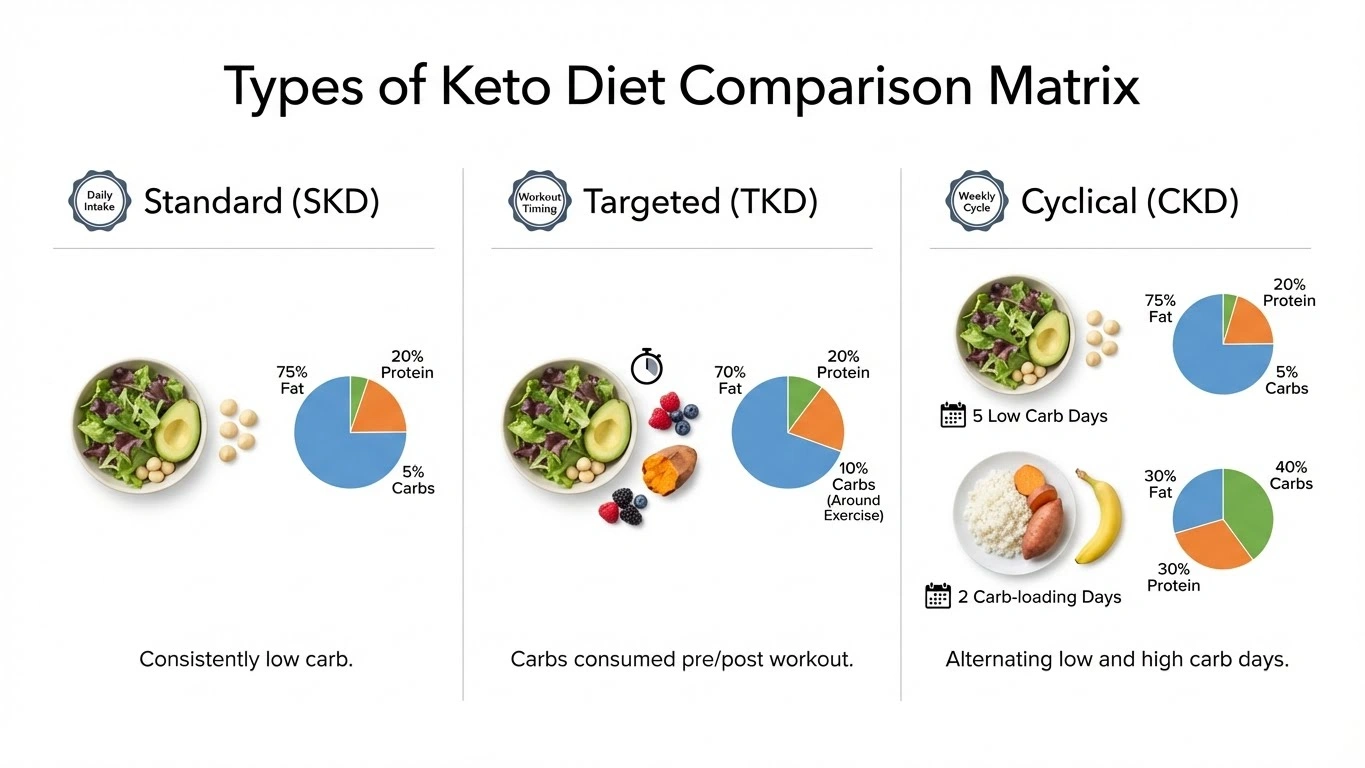
Who is it for
The Standard Ketogenic Diet is the foundational protocol recommended for approximately 99% of the population, including beginners, individuals seeking weight loss, those with type 2 diabetes, and therapeutic patients. If your activity level ranges from sedentary to moderate (jogging, yoga, light weightlifting), this is the correct setting for your calculator.
Metabolic Mechanism
The SKD relies on a consistent, linear restriction of carbohydrates. The macronutrient ratios typically generated by a calculator for SKD are:
- Fats: 70–75% of total caloric intake.
- Protein: 20–25% (moderate intake).
- Carbohydrates: 5% or less (typically under 30–50g per day).
By maintaining low carbohydrate intake consistently, blood glucose levels remain stable, and insulin secretion is minimized. This allows the body to access adipose tissue (body fat) for fuel efficiently. In clinical studies, this approach has shown strong adherence rates and is effective for reducing inflammation and improving metabolic health markers.
Calculator Inputs for SKD
- Carbohydrate Limit: Set this to Static or Standard. Input a hard limit, usually 20g to 30g of net carbs.
- Activity Level: Be conservative. Unless you are training professionally, select Sedentary or Lightly Active. The SKD does not require extra fuel for workouts because the body uses body fat for low-intensity energy needs.
- Protein Ratio: Set protein to 0.8g–1g per pound of lean body mass. High protein intake is rarely a concern for gluconeogenesis unless consumed in massive excess, but accuracy here prevents muscle loss.
Clinical Note: If you are sedentary or perform low-intensity cardio, adding carbohydrates via other types of keto diet will merely inhibit ketosis and halt lipolysis (fat burning).
Users who want to simplify SKD tracking without monitoring fat and protein can explore the lazy keto approach, which uses the same carb limit with a streamlined tracking method.
The Targeted Ketogenic Diet (TKD): Fueling the Anaerobic Athlete
Who is it for
The Targeted Ketogenic Diet is an advanced modification designed for individuals who regularly perform high-intensity interval training (HIIT), CrossFit, or heavy resistance training and experience a distinct drop in performance on SKD. It is not for beginners or those solely focused on weight loss.
Metabolic Mechanism
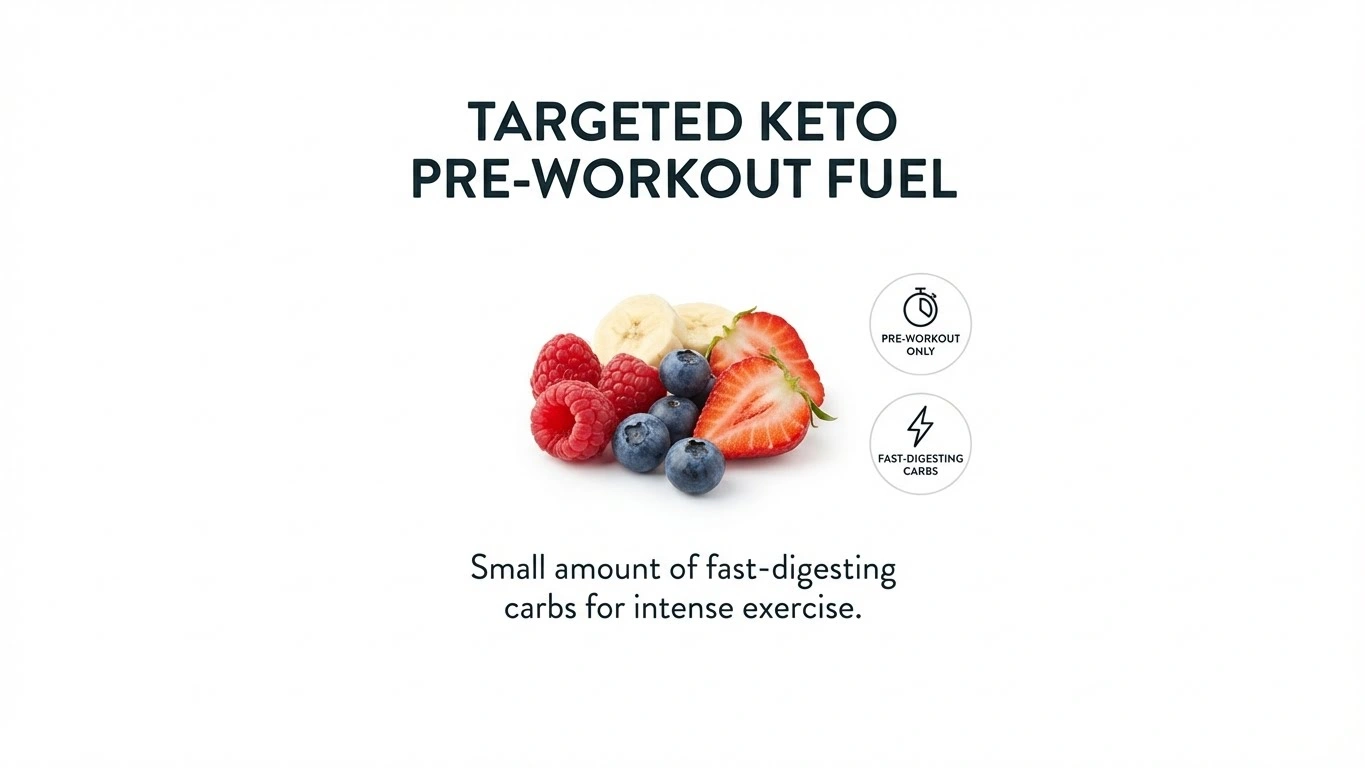
The TKD introduces a specific physiological strategy. It involves consuming a small bolus of fast-absorbing carbohydrates exclusively around the workout window (peri-workout).
- Pre-Workout: 25–50g of high-glycemic carbohydrates (like dextrose or glucose) are consumed 30–60 minutes before training.
- The Logic: These carbohydrates cause a rapid spike in blood glucose and insulin. Because consumption is targeted immediately before intense effort, the muscles utilize this glucose rapidly for explosive energy. The temporary exit from ketosis is short-lived — the activity burns off the glucose, allowing the athlete to return to ketosis shortly after the session concludes.
This protocol supports glycogen replenishment without the long-term interruption of ketosis seen in high-carb diets. For an understanding of how the keto calculator adjusts macro outputs for different protocols, see how the keto calculator works.
Calculator Inputs for TKD
Adjusting a calculator for the TKD requires precision to avoid overconsumption:
- Base Settings: Your baseline day should still look like an SKD (Standard) day.
- Workout Days: You must manually add the targeted carbohydrates to your daily allowance only on training days.
- Caloric Surplus: The 25–50g of carbohydrates represent an additional 100–200 calories. If your goal is weight loss, subtract these calories from your fat intake to maintain a deficit. If your goal is performance, these are additive calories.
- Carbohydrate Source: The calculator may not distinguish between carb types, but for effective TKD you must choose high-glycemic sources (dextrose, glucose gels) rather than fructose (fruit), as fructose replenishes liver glycogen and can interrupt ketosis longer than muscle-specific glucose.
Carb Sources for TKD: What to Use and What to Avoid
The type of carbohydrate matters for TKD as much as the amount. The goal is to fuel muscle glycogen rapidly, then deplete it completely during the workout window to minimize time outside ketosis.
- Best for TKD: Dextrose (pure glucose, fastest absorption), white rice, glucose gels or sports chews, white rice cakes — all are fast-absorbing and go directly to muscle glycogen.
- Avoid for TKD: Fructose-heavy sources (fruit, honey, agave) — fructose refills liver glycogen preferentially, extending time outside ketosis without directly fueling working muscles. High-fiber carbs (oats, legumes) are too slow. Mixed macros (protein bars) slow glucose absorption with fat and protein content.
How Long to Return to Ketosis After a TKD Carb Load?
Most fat-adapted athletes return to measurable ketosis (blood BHB above 0.5 mmol/L) within 2–4 hours after a high-intensity session. Recovery depends on workout intensity (higher intensity burns carbs faster), fat-adaptation depth (more adapted individuals rebound faster), and total carbs consumed (25g rebounds faster than 50g). Testing blood ketones post-workout is the most reliable way to verify the return window for individual TKD users.
The Cyclical Ketogenic Diet (CKD): Advanced Hypertrophy Protocol

Who is it for
Among the various types of keto diet, the Cyclical Ketogenic Diet is the most complex and is reserved for elite athletes, competitive bodybuilders, and those with advanced metabolic flexibility. It is suitable for individuals who require fully saturated glycogen stores for maximum muscle volume and sustained high-intensity output over prolonged periods.
Metabolic Mechanism
The CKD operates on a cycle of depletion and supercompensation.
- The Depletion Phase: For 5–6 days, the athlete follows a strict SKD protocol to deplete glycogen and upregulate ketone production.
- The Refeed Phase: For 1–2 days (typically the weekend), carbohydrate intake is drastically increased (carb-loading) to 60–70% of total calories, while fat intake is reduced to 5–10%.
The physiological intent is to completely refill muscle glycogen stores to super-physiological levels (supercompensation) to fuel the next week’s training volume. This is highly anabolic but kicks the body out of ketosis for 2–3 days per week. Athletes using CKD regularly need to understand how to get back into ketosis efficiently after each refeed phase.
Calculator Inputs for CKD
Standard calculators often fail to model CKD correctly because the macro split changes daily. You must use a calculator that allows for calorie cycling or macro cycling.
- Low Days (Mon–Fri): Input standard keto ratios (5% Carbs / 75% Fat / 20% Protein).
- High Days (Sat–Sun): You must manually override the settings. Input high carbohydrates (300–600g depending on muscle mass), moderate protein, and very low fat.
- Weekly Caloric Average: It is crucial to view your calories as a weekly average. The high-calorie refeed days can easily erase the caloric deficit created during the week if not strictly calculated.
Clinical Warning: The CKD causes significant water retention and weight fluctuation due to glycogen storage (1g of glycogen binds to 3–4g of water). This can be psychologically distressing for general weight loss patients and is physically demanding on the digestive system.
Targeted Ketogenic Diet vs. Cyclical Ketogenic Diet: Key Differences
Short answer: TKD adds 25–50g of fast carbs before individual workouts only — it stays close to ketosis. CKD replaces 2 full days per week with high-carb refeeds (150–300g) and exits ketosis intentionally. TKD suits daily exercisers. CKD suits competitive athletes on scheduled depletion and loading cycles.
Timing and scale: TKD adds a small carb bolus before individual high-intensity training sessions, consumed 30–60 minutes pre-workout on training days only. CKD follows a fixed weekly schedule: 5 days of strict SKD carb restriction followed by 2 full days of high-carb refeeding (150–300g of carbohydrates, sometimes more for larger athletes).
Effect on ketosis: TKD causes a brief, temporary exit from ketosis during the workout window. Intense exercise burns through the carbs rapidly, and most TKD users return to measurable ketosis within a few hours post-session. CKD intentionally exits ketosis for 2–3 days per week — this is by design. The goal is glycogen supercompensation, not maintenance of continuous ketosis.
Who each suits: TKD is appropriate for someone who trains daily at high intensity and finds performance suffering on SKD. CKD is appropriate for competitive bodybuilders or endurance athletes who require fully saturated glycogen stores for extended high-volume sessions.
What neither suits: Beginners, those primarily focused on fat loss, or anyone who has not completed at least 3 months of consistent SKD. Jumping to either variant before full fat-adaptation removes the metabolic advantage that makes keto effective for performance.
High-Protein Keto and Lazy Keto: Are They Real Keto Types?
Short answer: High-protein keto raises protein to 30–35% of calories while keeping carbs under 50g — it is a genuine keto variant. Lazy keto tracks only net carbs (not fat or protein) and is a simplified implementation of SKD, not a distinct protocol.
High-protein keto uses the same carb restriction as SKD (under 50g net carbs per day) but raises protein intake to 30–35% of total calories versus the standard 20–25%. This is popular among older adults and strength-focused athletes who prioritize muscle retention. The trade-off is that higher protein can increase gluconeogenesis — the liver’s conversion of amino acids to glucose — which may reduce blood BHB levels in some individuals. It does not eliminate ketosis in most people, but it may shift readings toward the lower end of the nutritional ketosis range (0.5–1.0 mmol/L rather than 1.0–3.0 mmol/L).
Lazy keto is a simplified implementation of SKD, not a distinct metabolic protocol. The carb limit (typically under 20–50g net carbs per day) is identical to SKD. The difference is tracking: lazy keto monitors only net carbohydrates, not fat or protein. The lazy keto guide explains how to structure this approach for long-term use. The lazy keto calculator generates simplified daily carb targets without requiring full macro inputs.
For anyone wanting precision — particularly those using a full keto calculator to set a caloric deficit for fat loss — full SKD macro tracking produces more predictable results. Lazy keto is more sustainable for some people and produces acceptable results when carb limits are respected consistently.
Comparative Analysis: SKD vs. TKD vs. CKD
For a full side-by-side comparison including high-protein keto and lazy keto, see the comparison table at the top of this page. The summary below covers the core practical trade-offs between the three main types of keto diet for calculator configuration purposes.
- Standard (SKD):
Goal: Weight Loss / Metabolic Health
Target: 99% of people (Beginners)
Carbs: Static (20–50g/day)
Complexity: Low - Targeted (TKD):
Goal: Workout Performance
Target: HIIT / CrossFit Athletes
Carbs: Static + Pre-workout (25–50g on training days)
Complexity: Moderate - Cyclical (CKD):
Goal: Muscle Hypertrophy / Elite Sport
Target: Bodybuilders / Endurance Professionals
Carbs: Cycle Low (5 days) + High (2 days)
Complexity: Very High
As noted in the medical literature, unless you are hitting the wall or experiencing bonking during high-intensity training, there is no physiological need to add carbohydrates. The SKD is sufficient for full-body adaptation and fat loss for most people.
Conclusion: Which Calculator Setting Should You Choose?
In the analysis of the various types of keto diet, the correct calculator setting depends entirely on your metabolic reality, not your aspirations.
- Select Standard (SKD) if: You are new to keto, your primary goal is weight loss, you have a sedentary to moderately active lifestyle, or you are managing metabolic syndrome. This is the appropriate protocol for the vast majority of users. Use the keto calculator for weight loss to generate your specific SKD macro targets.
- Select Targeted (TKD) if: You are a fat-adapted athlete (at least 3 months on keto) who experiences a verified loss of power during explosive movements (HIIT/CrossFit) and cannot complete workouts without hitting a wall.
- Select Cyclical (CKD) if: You are an advanced bodybuilder or elite endurance athlete with years of tracking experience, capable of strict adherence to depletion workouts and rigorous refeed calculations.
For the vast majority of users visiting a free keto calculator, the Standard Ketogenic Diet is the optimal path. It offers the highest sustainability, the most consistent metabolic benefits, and the lowest margin for error. Master the basics of SKD before attempting to manipulate the delicate biochemistry of targeted or cyclical protocols. If you are interested in combining keto with additional metabolic strategies, intermittent fasting on keto pairs naturally with SKD for those who want to accelerate fat loss.
Frequently Asked Questions: Types of Keto Diet
What are the main types of keto diet?
The five most commonly recognized types are: Standard Ketogenic Diet (SKD), Targeted Ketogenic Diet (TKD), Cyclical Ketogenic Diet (CKD), High-Protein Keto, and Lazy Keto. SKD is the baseline and works for most people. TKD and CKD add strategic carbohydrates for athletic performance. High-protein keto increases the protein ratio. Lazy keto tracks only net carbs without monitoring fat or protein.
Which type of keto diet is best for beginners?
The Standard Ketogenic Diet (SKD) is the correct starting point for all beginners. It keeps net carbs under 20–50g per day consistently and requires no special carb timing or cycling. It is effective for weight loss, achievable without athletic experience, and produces reliable fat adaptation. TKD and CKD should not be attempted until at least 3 months of consistent SKD has established full fat-adaptation.
What is the difference between SKD and TKD?
SKD restricts carbs consistently to under 20–50g per day with no timing structure. TKD adds 25–50g of fast-absorbing carbohydrates immediately before high-intensity workouts on training days only. SKD is for the general population and weight loss goals. TKD is for fat-adapted athletes who experience performance decline on standard keto during explosive exercise like HIIT or CrossFit.
What is the difference between TKD and CKD?
TKD adds small pre-workout carb doses (25–50g) on training days while maintaining near-continuous ketosis. CKD runs a weekly cycle of 5 strict keto days followed by 2 full high-carb refeed days (150–300g of carbohydrates), intentionally exiting ketosis each week. TKD is for daily high-intensity exercisers. CKD is for competitive bodybuilders or elite athletes who need fully saturated glycogen for high training volumes.
Which type of keto is best for weight loss?
The Standard Ketogenic Diet (SKD) is the most effective type of keto diet for weight loss. It maintains consistent fat adaptation and is the most studied protocol in weight loss research. TKD and CKD both involve carbohydrate additions that reduce the fat-burning rate. Unless there is a specific athletic performance requirement, SKD is the correct choice for fat loss goals.
Can I switch between types of keto diet?
Yes, but in a logical progression. Start with SKD and remain on it until fully fat-adapted — at minimum 3 months, ideally 4–6 months. From there, TKD is the natural next step for those with high-intensity training needs. CKD is only appropriate after extended experience with both SKD and TKD. Switching too early removes the metabolic advantage that makes keto effective.
Do I need a different keto calculator for TKD or CKD?
Standard keto calculators generate SKD targets. For TKD, use the base SKD output and manually add 25–50g of carbohydrates on training days, subtracting the caloric equivalent from fat intake if weight loss is the goal. CKD requires separate calculations for low days and high days. See how the keto calculator works for the methodology behind the macro outputs.
Is lazy keto a real type of keto diet?
Lazy keto is a simplified version of SKD, not a distinct metabolic protocol. The carb restriction is identical (under 20–50g net carbs per day), but fat and protein intake are not tracked. This removes macro precision. Lazy keto can be an effective starting point for those who find full tracking unsustainable. For faster or more predictable fat loss, full SKD tracking is more reliable.
What is high-protein keto, and is it effective?
High-protein keto uses the same carb restriction as SKD (under 50g net carbs per day) but raises protein to 30–35% of total calories versus the standard 20–25%. It is effective for muscle retention and is popular with strength athletes and older adults. The trade-off is that higher protein may lower blood BHB levels compared to standard keto — though most high-protein keto followers still maintain measurable nutritional ketosis.
How long should I stay on SKD before trying TKD?
At minimum 3 months of consistent Standard Ketogenic Diet before attempting TKD — ideally 4–6 months. Full fat-adaptation takes most people 4–12 weeks to develop. Attempting TKD before this adaptation is complete defeats its purpose: if the body is not yet efficient at burning fat, adding pre-workout carbs simply refuels glucose dependence rather than supplementing an established fat-burning engine.
Further Reading & Tools
Start here before comparing keto types — the SKD baseline explained for new practitioners.
How to implement simplified keto by tracking only net carbs — no fat or protein counting required.
Calculate your daily net carb target using the simplified lazy keto approach.
How 16:8 fasting pairs with SKD for appetite control and accelerated fat loss.
The foundational science behind ketogenesis and why carb restriction triggers fat burning.
Set your SKD, TKD, or weight loss macros using the free calculator — no sign-up required.
Explore More Resources
For additional information check out these excellent resources on keto and metabolic health: