TDEE vs BMR: What’s the Difference? (Free Calculator)
BMR is what your body burns at rest. TDEE is what you burn in a whole day. Calculate both in 30 seconds and see how many calories to eat for your goal.
🔥 Calculate my TDEE and BMRTDEE vs BMR: The Difference Between BMR and TDEE
BMR (basal metabolic rate) is the calories your body burns at complete rest just to keep you alive: about 60–70% of what you burn in a day. TDEE (total daily energy expenditure) is BMR plus digestion (about 10%) plus all movement and exercise. TDEE is usually 1.2–1.9 × BMR. Eat by TDEE, not BMR: eating your TDEE keeps your weight stable, and eating 10–20% below it leads to weight loss.
| BMR | TDEE | |
|---|---|---|
| Stands for | Basal Metabolic Rate | Total Daily Energy Expenditure |
| What it measures | Calories your body burns at complete rest to stay alive | All calories you burn in a day, including food digestion and movement |
| Includes | Breathing, heartbeat, brain, organs, body temperature | BMR + thermic effect of food + exercise + everyday movement |
| Typical size | About 60–70% of TDEE | 100% (usually 1.2–1.9 × BMR) |
| Changes with activity? | No | Yes, a lot |
| Use it for | Understanding your baseline | Setting how much to eat to lose, keep or gain weight |
🔥 TDEE and BMR Calculator
Enter your details to see your BMR, your TDEE and calorie targets for your goal.
Estimates for healthy adults. Not for pregnancy, breastfeeding or under-18s.
Turn Your Calories Into a Keto Meal Plan
Get the free 3-Day Keto Reset Plan: simple meals, an electrolyte schedule and a shopping list to start eating at your new calorie target.
- ✅ 3 days of meals
- ✅ Electrolyte schedule
- ✅ Shopping list
Free PDF sent to your inbox. No spam. See our Privacy Policy.
What Is BMR (Basal Metabolic Rate)?
BMR is the minimum energy your body needs at complete rest: to breathe, pump blood, run your brain and organs and keep your temperature stable. If you stayed in bed all day and ate nothing, you would still burn roughly your BMR.
BMR depends mostly on your body size and composition. Bigger bodies and more muscle burn more; BMR also declines slowly with age. That is why the formulas use your weight, height, age and sex, or your lean body mass if you know your body fat percentage.
BMR vs RMR: BMR is measured in a lab after sleep and fasting, fully at rest. RMR (resting metabolic rate) is measured under looser conditions and comes out slightly higher. Online calculators, including ours, treat them as the same thing.
What Is TDEE (Total Daily Energy Expenditure)?
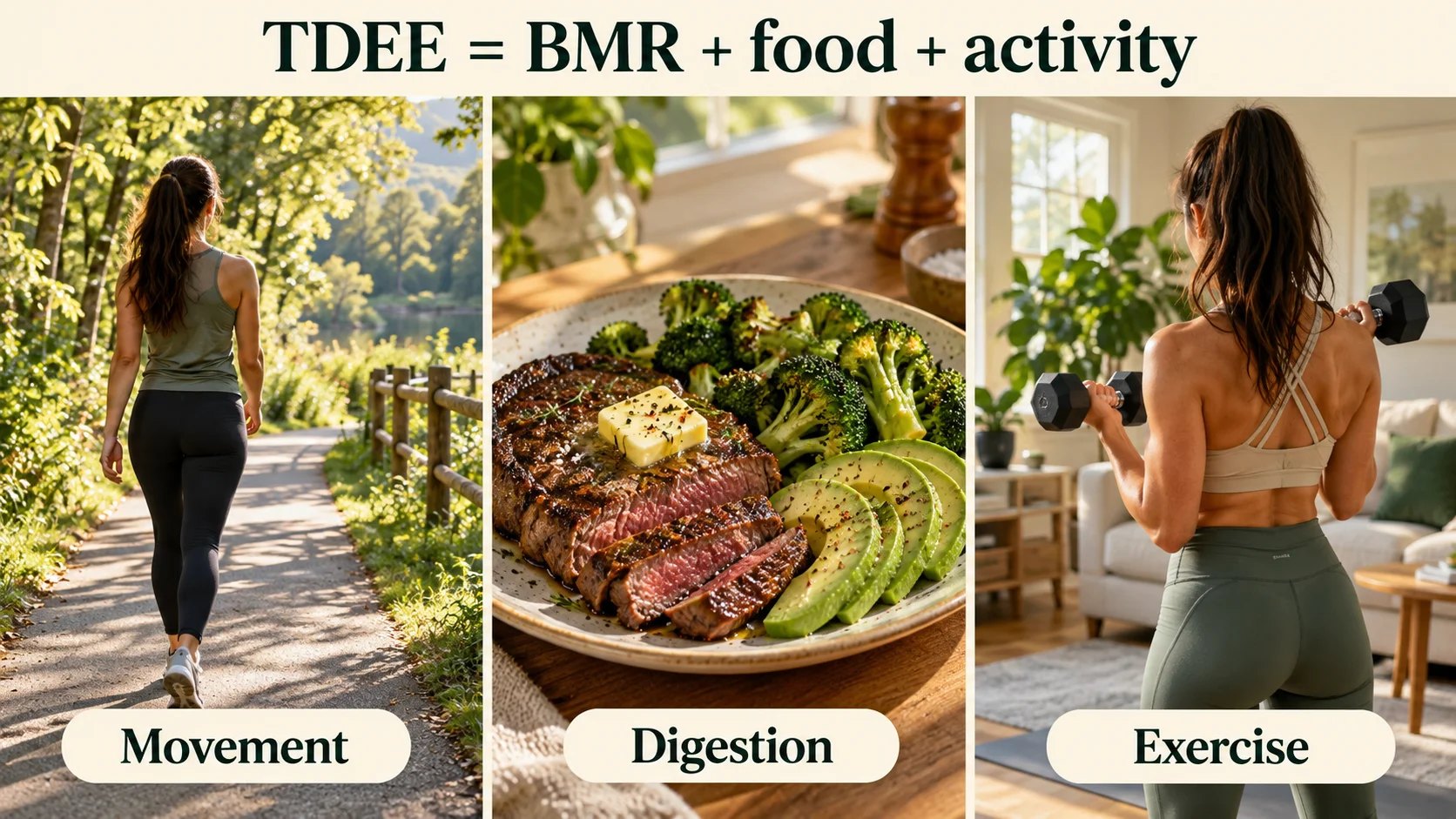
TDEE is the total number of calories you burn in 24 hours. It is your BMR plus the energy used to digest food plus all physical activity, from workouts to walking to the kitchen.
| Component | Share of TDEE | What it is |
|---|---|---|
| BMR / resting energy | About 60–70% | Energy to keep organs working at rest |
| Thermic effect of food (TEF) | About 10% | Energy used to digest and absorb food; highest for protein |
| Exercise (EAT) | Varies | Planned workouts: gym, running, sports |
| Everyday movement (NEAT) | Varies | Walking, standing, chores, fidgeting |
| Activity total (EAT + NEAT) | About 15% (sedentary) to 50% (very active) | The part you control most |
BMR and the thermic effect of food are fairly stable. Activity is the part that changes most from person to person and from day to day. Two people with the same BMR can have TDEEs 800 kcal apart just because one sits all day and the other walks 12,000 steps.
How to Calculate BMR and TDEE: Formulas
Step 1: calculate BMR with the Mifflin-St Jeor equation (or Katch-McArdle if you know your body fat). Step 2: multiply BMR by your activity factor, from 1.2 (sedentary) to 1.9 (extra active). The result is your TDEE.
Step 1: BMR formulas
| Formula | Equation | Best for |
|---|---|---|
| Mifflin-St Jeor (men) | 10 × weight (kg) + 6.25 × height (cm) − 5 × age + 5 | Most adults; the most accurate general equation in reviews |
| Mifflin-St Jeor (women) | 10 × weight (kg) + 6.25 × height (cm) − 5 × age − 161 | Most adults |
| Katch-McArdle | 370 + 21.6 × lean body mass (kg) | People who know their body fat %, especially lean or muscular people |
| Harris-Benedict (revised) | Older equation from 1919, revised 1984 | Often overestimates; kept for comparison |
A systematic review found Mifflin-St Jeor was the most reliable of the common equations, predicting resting energy within 10% for most people. That is why our calculator uses it by default and switches to Katch-McArdle when you enter your body fat.
Step 2: activity multipliers
| Activity level | Multiplier | Example |
|---|---|---|
| Sedentary | 1.2 | Desk job, little exercise |
| Lightly active | 1.375 | Light exercise 1–3 days a week |
| Moderately active | 1.55 | Exercise 3–5 days a week |
| Very active | 1.725 | Hard exercise 6–7 days a week |
| Extra active | 1.9 | Physical job plus training |
Tip: most people overestimate how active they are. If you are unsure between two levels, pick the lower one.
Worked Example: BMR vs TDEE
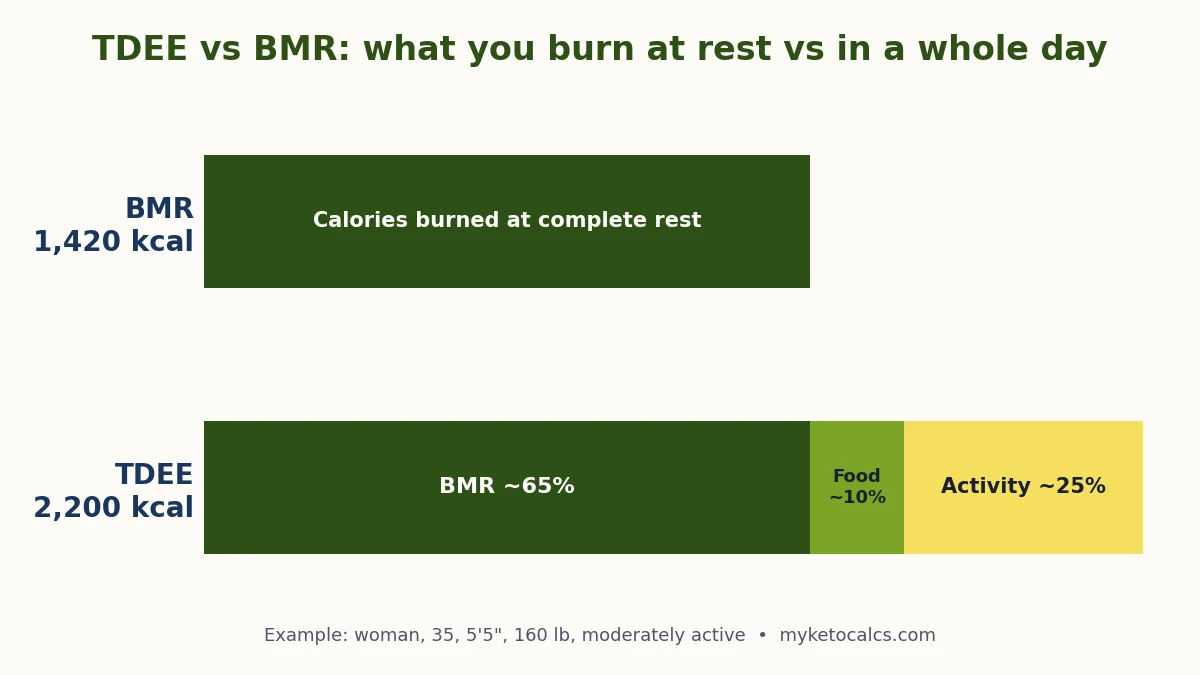
A 35-year-old woman, 5 ft 5 in (165 cm), 160 lb (72.6 kg), who exercises 3–5 days a week:
- BMR (Mifflin-St Jeor): 10 × 72.6 + 6.25 × 165.1 − 5 × 35 − 161 = about 1,420 kcal
- TDEE: 1,420 × 1.55 = about 2,200 kcal
- Weight loss target (TDEE − 20%): about 1,760 kcal
Her TDEE is almost 800 kcal higher than her BMR. If she ate at her BMR of 1,420 kcal, she would be in a deficit of about 35%, which is hard to sustain and makes it difficult to get enough protein. Eating around 1,760 kcal gives steady fat loss of about 1 lb a week.
Should You Eat Your TDEE or Your BMR?
Use TDEE to set your calories. Eat at TDEE to maintain, 10–20% below TDEE to lose weight and 5–10% above TDEE to gain muscle. BMR is a baseline for understanding your metabolism, not a daily eating target.

| Goal | Daily calories | What to expect |
|---|---|---|
| Maintain weight | TDEE | Weight stays stable |
| Gentle fat loss | TDEE − 10% | Slow, easy to sustain |
| Standard fat loss | TDEE − 20% | About 0.5–1% of body weight per week |
| Muscle gain | TDEE + 5–10% | Slow gain with training |
Is it bad to eat below your BMR?
Eating a bit below BMR is common and not dangerous for most healthy adults: with a sedentary TDEE, a 20% deficit often lands near BMR. The real risk is very large deficits that make it hard to eat enough protein, vitamins and minerals, and that speed up muscle loss. Unless a doctor is supervising you, most women should stay above about 1,200 kcal a day and most men above about 1,500 kcal.
TDEE and BMR on a Keto Diet
Keto does not change how you calculate TDEE. In a tightly controlled NIH metabolic-ward study, switching to a ketogenic diet at the same calories raised energy expenditure by about 100 kcal a day or less, and it did not speed up body fat loss. Calories still count on keto; what keto changes is how easy it is for many people to eat fewer of them, because fat and protein are filling.
Once you know your TDEE, the next step on keto is to split your calories into macros: net carbs (usually 20–30 g), enough protein to protect muscle and the rest from fat. Our free keto calculator does that for you, and the keto calculator for weight loss adds a goal date and deficit.
In the first week of keto, the scale often drops 2–5 lb. That is mostly water released with glycogen, not a sudden jump in TDEE. Real fat loss follows your calorie deficit.
TDEE vs BMR: FAQ
What is the difference between BMR and TDEE?
BMR (basal metabolic rate) is the number of calories your body burns at complete rest just to stay alive. TDEE (total daily energy expenditure) is everything you burn in a day: BMR plus the energy to digest food plus all movement and exercise. TDEE is always higher than BMR, usually 1.2 to 1.9 times higher.
Should I eat my TDEE or my BMR?
Base your intake on TDEE. Eating your TDEE keeps your weight stable. To lose weight, eat about 10–20% below TDEE. BMR is your baseline, not a calorie target.
Is it bad to eat below your BMR?
Not automatically. For many people a normal weight-loss target (TDEE minus 15–20%) lands close to or slightly below BMR, and that is fine short term. Very large deficits, far below BMR, make it hard to get enough protein and nutrients and can increase muscle loss. Most adults should not go below about 1,200 kcal (women) or 1,500 kcal (men) a day without medical supervision.
How accurate are TDEE calculators?
They are estimates. The Mifflin-St Jeor equation predicts resting energy within about 10% for most people, and activity multipliers add more uncertainty. Use the result as a starting point, track your weight for 2–3 weeks and adjust by 100–200 kcal if needed.
What percentage of TDEE is BMR?
For most people, BMR or resting energy is about 60–70% of TDEE. The thermic effect of food adds about 10%, and physical activity makes up the rest, from about 15% in sedentary people to 50% in very active people.
Is BMR the same as RMR?
Almost. BMR is measured under strict conditions (after a night’s sleep, fasted, fully at rest). RMR (resting metabolic rate) is measured under less strict conditions and is usually slightly higher. Calculators use the terms interchangeably.
Does keto increase your TDEE?
Only slightly, if at all. In a tightly controlled NIH study, switching to a ketogenic diet at the same calories raised energy expenditure by about 100 kcal a day or less, and it did not speed up body fat loss. Calories still matter on keto, so plan with your normal TDEE.
How often should I recalculate my TDEE?
Recalculate every 10 lb (about 5 kg) of weight change or when your activity level changes. As you lose weight, both BMR and TDEE go down, so your calorie target should come down too.
Data & Sources
- Mifflin-St Jeor equation: Mifflin et al., American Journal of Clinical Nutrition, 1990 (PubMed).
- Accuracy of BMR equations: Frankenfield et al., systematic review, 2005 (PubMed).
- TDEE components (resting energy 60–70%, thermic effect of food about 10%, activity 15–50%): National Academies, Dietary Reference Intakes for Energy (NCBI Bookshelf).
- Ketogenic diet and energy expenditure: Hall et al., American Journal of Clinical Nutrition, 2016 (PubMed).
- Protein and muscle during weight loss: Cava et al., Advances in Nutrition, 2017.
- Glycogen and water weight: PubMed: glycogen and body water.