How to Calculate Keto Macros: 5 Steps With a Worked Example
Keto macros come from your calories: estimate BMR, multiply by activity to get TDEE, adjust for your goal, then split 70% fat, 25% protein and 5% net carbs and convert to grams.
Macro worksheet: see every step
Prefer one click? Use the free keto calculator →How to Calculate Keto Macros: Quick Answer
Short answer: calculate BMR with Mifflin-St Jeor, multiply by an activity factor (1.2–1.9) to get TDEE, subtract 20% to lose weight, then take 70% of the calories as fat, 25% as protein and 5% as net carbs. Divide fat calories by 9 and protein and carb calories by 4. Example: 1,730 kcal → 135 g fat, 108 g protein, 22 g net carbs.
How to Calculate Keto Macros in 5 Steps
Keto macros are three numbers: grams of fat, protein and net carbs per day. You get them from your daily calorie target. Here is the method our free keto calculator uses, written out so you can check it by hand.
Estimate your BMR
Basal metabolic rate is the energy you burn at rest. The Mifflin-St Jeor equation is the standard estimate:
Women: 10 × weight (kg) + 6.25 × height (cm) − 5 × age − 161
Men: 10 × weight (kg) + 6.25 × height (cm) − 5 × age + 5Using pounds and inches? Divide pounds by 2.2046 and multiply inches by 2.54 first.
Multiply by your activity factor (TDEE)
Total daily energy expenditure adds your activity on top of BMR.
Activity Typical week Multiply BMR by Sedentary Desk job, little or no exercise 1.2 Light 1–3 workouts or daily walks 1.375 Moderate 3–5 workouts 1.55 Very active 6–7 workouts 1.725 Extra active Physical job or training twice a day 1.9 Most people overestimate their activity. If you are unsure between two levels, pick the lower one. More on the difference in TDEE vs BMR.
Adjust for your goal
To lose weight, eat about 20% below TDEE (TDEE × 0.80). To maintain, eat at TDEE. To gain, eat about 15% above (TDEE × 1.15).
Split calories into macros
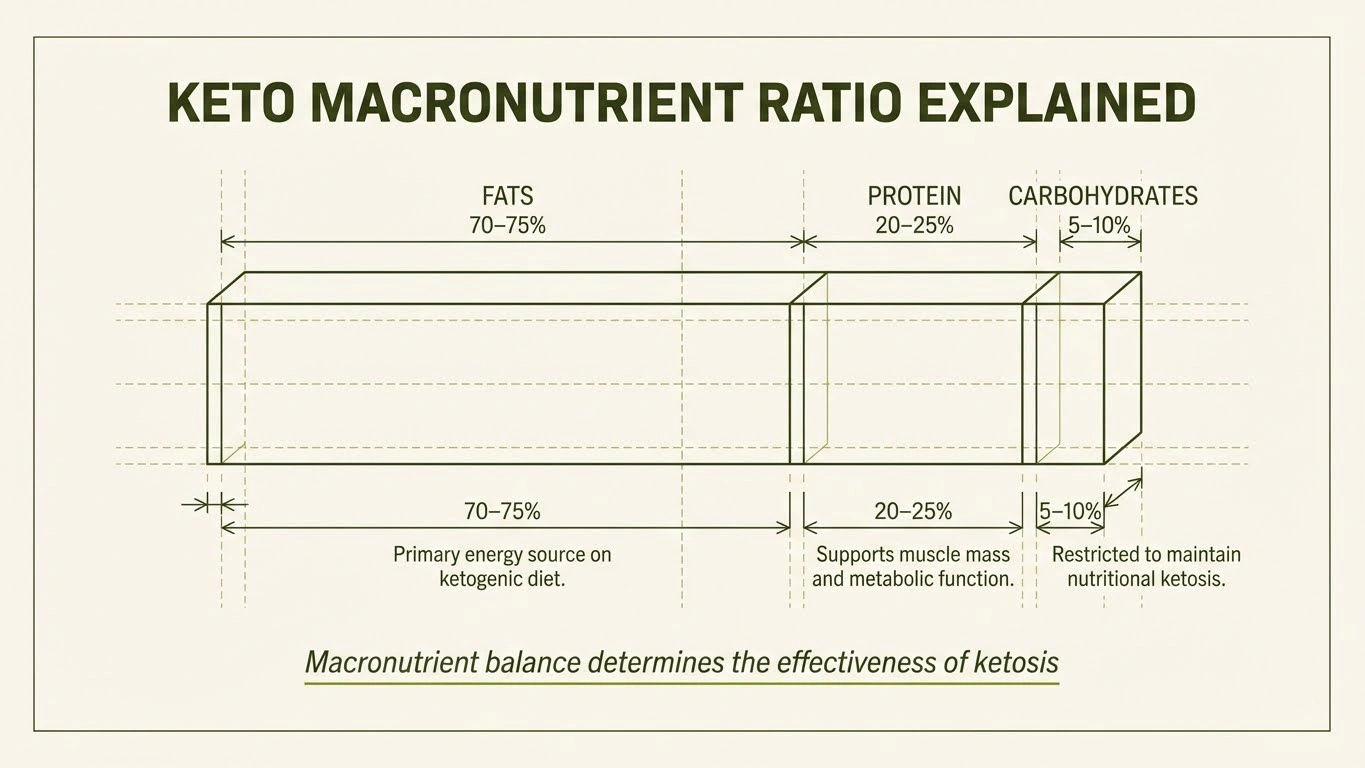
Use 70% of calories for fat, 25% for protein and 5% for net carbs. Then convert to grams: fat has 9 kcal per gram, protein and carbs 4 kcal per gram.
Fat g = calories × 0.70 ÷ 9
Protein g = calories × 0.25 ÷ 4
Net carbs g = calories × 0.05 ÷ 4Sanity-check the result
Net carbs usually land between 20 and 50 g a day — the range commonly used for ketosis. If yours is under 20 g, rounding up to 20 g is a simple, common choice. For protein, compare the result with our guide to how much protein on keto.
Worked Example: Keto Macros for a 35-Year-Old Woman
Female, 35 years, 165 cm (about 5 ft 5 in), 70 kg (about 154 lb), moderately active, goal: lose weight.
| Step | Calculation | Result |
|---|---|---|
| 1. BMR | 10 × 70 + 6.25 × 165 − 5 × 35 − 161 | 1,395 kcal |
| 2. TDEE | 1,395 × 1.55 | 2,163 kcal |
| 3. Target | 2,163 × 0.80 | 1,730 kcal |
| 4. Fat | 1,730 × 0.70 ÷ 9 | 135 g |
| 4. Protein | 1,730 × 0.25 ÷ 4 | 108 g |
| 4. Net carbs | 1,730 × 0.05 ÷ 4 | 22 g |
Her daily keto macros: about 135 g fat, 108 g protein and 22 g net carbs on 1,730 kcal. Net carbs fall inside the 20–50 g range, and protein works out to about 1.5 g per kg of body weight.
Got your macros? Start with the free 3-Day Keto Reset Plan
Three days of simple keto meals and a shopping list, so your new numbers turn into food on the plate.
- ✅ 3 days of meals
- ✅ Shopping list
- ✅ Printable PDF
Free PDF sent to your inbox. No spam. See our Privacy Policy.
Common Mistakes When Calculating Keto Macros
- Counting total carbs instead of net carbs. Keto targets are net carbs — total carbs minus fiber. See net carbs vs total carbs.
- Picking an activity level that is too high. A higher factor adds hundreds of calories. Start lower and adjust from real results.
- Treating fat as a target you must hit. When losing weight, fat is the flexible number; protein and net carbs are the ones to keep steady.
- Never recalculating. As your weight drops, so does your TDEE. Recalculate every 5 kg (10 lb) or after a long stall — see recalculating macros for a keto plateau.
- Forgetting the estimate is an estimate. Track your weight for 2–4 weeks and adjust calories by about 100–200 kcal if progress stalls.
When to Use a Different Calculator
The steps above fit most adults. For specific situations we have calculators with adjusted inputs:
- Keto calculator for women over 50
- Vegan keto calculator
- Lazy keto calculator — if you only want to track carbs
- Keto calculator for runners
Pregnant or breastfeeding, under 18, or managing diabetes, kidney disease or another medical condition? Do not set keto macros on your own — talk to your doctor first.

Have your macros? Get 30 days of meals that match them
Every day is planned, every recipe has its macros, and the shopping lists are done — about 18 g net carbs a day.
- ✅ 30 days of breakfasts, lunches, dinners and snacks
- ✅ About 18 g net carbs a day, macros worked out for you
- ✅ 32 easy recipes with photos and weekly shopping lists
Instant PDF download. Shop at Walmart? Get the Walmart Shopping Edition with exact products and package counts.
How to Calculate Keto Macros: FAQ
How do you calculate keto macros?
Five steps: estimate your resting calories (BMR) with the Mifflin-St Jeor equation, multiply by an activity factor to get TDEE, adjust for your goal (for example −20% to lose weight), split the calories 70% fat, 25% protein and 5% net carbs, then divide by 9 for fat and 4 for protein and carbs to get grams.
What is the standard keto macro ratio?
MyKetoCalcs uses 70% of calories from fat, 25% from protein and 5% from net carbs. What matters most for ketosis is keeping net carbs low — usually 20–50 g a day.
How many carbs should I eat on keto?
Most keto plans keep net carbs between 20 and 50 g a day. With the 5% rule, a 1,730 kcal target gives about 22 g. If your number comes out under 20 g, rounding up to 20 g is a common, simple choice.
Do I count net carbs or total carbs on keto?
Most keto plans count net carbs: total carbohydrates minus fiber. Fiber is not absorbed like sugar. Our calculators and food lists all use net carbs.
Should I recalculate my macros as I lose weight?
Yes. A lower body weight means a lower BMR and TDEE, so your calorie target drops too. Recalculating every 5 kg (10 lb) or when weight loss stalls for several weeks is a practical rule.
Is the result exact?
No. The Mifflin-St Jeor equation estimates resting energy for groups of people; your real needs can be higher or lower. Treat the result as a starting point, track your weight for 2–4 weeks and adjust calories up or down.
Data and Sources
- BMR equation: Mifflin MD, St Jeor ST et al. A new predictive equation for resting energy expenditure in healthy individuals. Am J Clin Nutr (1990).
- Energy per gram of fat (9 kcal) and protein and carbohydrate (4 kcal): FAO, Food energy — methods of analysis and conversion factors (2003).
- Carb limits for ketosis (20–50 g net carbs a day): Paoli et al., European Journal of Clinical Nutrition (2013); The Ketogenic Diet, StatPearls (NCBI Bookshelf).
- The method and ratios match the MyKetoCalcs keto calculator.